
When Grace Interrupts Our Plans
by Dr Kausthub Desikachar, PhD
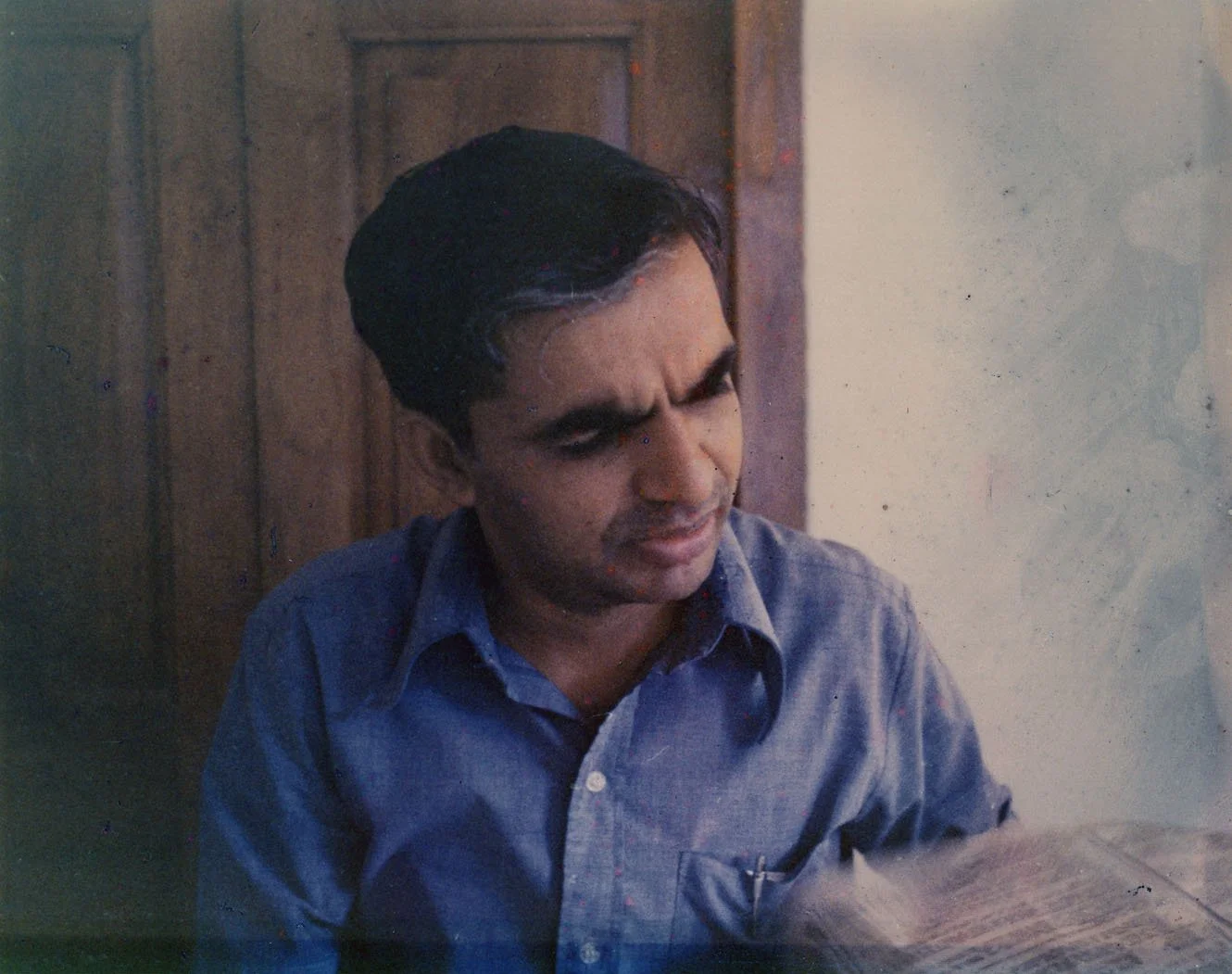
A Young TKV Desikachar, relaxing at his home, reading a newspaper!
A Life Continues to Unfold
In the first part of this series, we explored the foundations of TKV Desikachar’s life—his lineage, the world into which he was born, and the powerful presence of his father, Tirumalai Krishnamacharya. This second article turns to a quieter, yet decisive, turning point. Not a moment marked by dramatic proclamation or deliberate ambition, but a simple encounter that gently, and irrevocably, redirected the course of his life.
Often, life does not speak to us through grand events. It speaks through interruptions—through moments that arrive unannounced, disturb our carefully laid plans, and ask something uncomfortable of us. These moments rarely appear important when they occur. Their significance reveals itself only when we are willing to pause, notice, and respond. This is the story of one such moment—an encounter that carried within it the unmistakable weight of grace.
A Childhood Like Any Other, and One That Was Not
Desikachar’s childhood was, in many respects, entirely ordinary. Growing up in India in the 1940s and 50s, he went to school, played endlessly with friends, climbed coconut trees, and stole jackfruit from a neighbour’s garden. He loved hiking up Chamundi Hill and, like many boys his age, delighted in mischief. One of his favourite pranks involved placing a freshly fried vada on a teacher’s chair and waiting for the inevitable reaction.
His father had little tolerance for such behaviour. Discipline and seriousness were central to Krishnamacharya’s nature. Order, precision, and responsibility shaped his worldview, and frivolity rarely escaped correction. Yet Desikachar was often spared the harshest consequences through the quiet interventions of his mother, Namagiriammal, whose presence softened the sharp edges of household discipline. She understood intuitively that growth requires both firmness and compassion.
What truly set Desikachar apart from other children was not his behaviour, but his home. He was growing up in the household of an influential and demanding Yoga master. And yet, Yoga itself held little appeal for him. His father did not insist that he practice, nor did he impose his own path upon his son. Instead, he allowed interest to arise—or not—on its own. At times, he would tempt Desikachar to demonstrate postures before visiting dignitaries or invite him to participate in friendly competitions at the Yoga Shala in Mysore. These efforts sparked curiosity only briefly. Yoga entered Desikachar’s life in passing, never staying long enough to take root.
In hindsight, this absence of pressure was itself a form of wisdom. The path of Yoga, Krishnamacharya understood, cannot be inherited. It must be chosen. And at this stage of his life, Desikachar was not yet ready to choose it.
The Engineer’s Path, Clearly Laid Out
By the time he turned eighteen, Desikachar’s attention had shifted decisively elsewhere. He enrolled in Civil Engineering at the University of Mysore and quickly distinguished himself as a capable and focused student. By then, his family had moved to Chennai, and remaining in Mysore afforded him independence, space, and a sense of self beyond his father's powerful orbit.
He graduated at the top of his class and was immediately offered a well-paying position in North India. For the family, this was a moment of pride and relief. Desikachar was the first engineer among them. His future appeared stable, respectable, and secure.
Krishnamacharya supported his son’s decision without hesitation. He knew the sacrifices his own life had demanded—financial uncertainty, social marginalization, and years of struggle for recognition. Yoga was not a respected profession in those days, and it had never occurred to anyone that Desikachar would choose to follow that path. Everyone expected him to build bridges of concrete and steel. Desikachar himself shared that expectation.
The plan was sensible. Logical. Even admirable.
And yet, as spiritual life so often reveals, sensibility is not always destiny.
A Morning That Would Not Let Go
During a routine holiday visit home in the early 1960s, Desikachar sat on the verandah one morning, reading the newspaper. The day began like any other. Then an expensive car stopped in front of their modest home. A Western woman in her fifties stepped out hurriedly, calling out, “Professor! Professor!”
Before Desikachar could respond, his father appeared. To his astonishment, the woman embraced Krishnamacharya with visible emotion, repeatedly thanking him before being led inside.
Such a display was deeply unusual. In India, especially among conservative families, public affection between men and women is rare—even between spouses. The image unsettled him. It did not fit into any framework he understood.
When the woman eventually departed, Desikachar asked his father who she was and why she had embraced him so openly.
Krishnamacharya replied simply that she was Mrs Malvenan, from New Zealand, and that she had suffered from insomnia for many years. The previous night was the first time she had slept without medication. Overcome with gratitude, she had come to thank him.
At that moment, something shifted irrevocably for Desikachar.
He would later recall:
“I was amazed that this wealthy woman, who could afford the best Western medical care, found relief with my father—a simple man who knew no English and no modern medicine. That is when I understood how great he truly was, and how great a teacher he carried.”
This was not the first time he had heard of his father’s healing abilities, but it was the first time he had seen their power so clearly. Not as a theory. Not as a reputation. But as lived reality.
In that instant, the life he had planned for himself quietly dissolved.
When Grace Interrupts Our Plans
Looking back, it is difficult to dismiss this moment as a coincidence. Desikachar happened to be home that morning. Mrs Malvenan arrived unexpectedly. Neither planned the encounter, yet it unfolded with precise inevitability.
Spiritual life teaches us something both humbling and unsettling: that while our plans may be thoughtful and sincere, they are not always the ones that shape our lives. Grace does not consult our intentions. It arrives when it chooses, often in forms we do not recognise at first.
Many people encounter such moments and move past them. Others recognise them only years later. For Desikachar, recognition was immediate. Once seen, it could not be unseen.
To respond to grace is never easy. It demands that we loosen our grip on certainty. It asks us to step away from identities that feel safe and toward paths that feel exposed. Grace does not guarantee comfort. It offers direction—and leaves the courage to us.
Desikachar chose to respond. He resolved to give up his career in engineering and become a student of Yoga.
Tested by the Teacher
When Desikachar shared his decision, Krishnamacharya did not immediately accept him as a student. Instead, he tested him—quietly, rigorously, and without concession.
Lessons began at two o’clock in the morning, with the chanting of the Haṭhayogapradīpikā, the first text Krishnamacharya taught his son. In a small household, this was deeply disruptive. Family members were irritated, their sleep disturbed by the steady cadence of chanting that echoed through the early hours.
This was not accidental. Krishnamacharya was not merely testing discipline. He was observing whether his son possessed the inner resilience required for the spiritual path—whether he could remain steady in the face of inconvenience, criticism, and discomfort. Whether he could commit to something sacred even when it disturbed the fragile harmony of daily life.
Years later, when I myself decided to become a Yoga teacher, my father sat me down and spoke to me with the same unvarnished honesty. He did not encourage me. Instead, he warned me. He told me that this path would not be easy, that it was often thankless, and that many students would take as much as they could without feeling any sense of gratitude in return. Even those who posed to be close or reliable. He spoke not with bitterness but with clarity, drawing on his long experience of teaching.
He had faced such circumstances many times himself—moments of deep ingratitude, misunderstanding, and even active opposition. He told me plainly that I should be prepared for the same and that if I chose this path, I must not expect validation or appreciation to sustain me. In time, his words proved accurate. I have faced ingratitude, and at times, far worse—people attempting to undermine my work or diminish my efforts.
And yet, because my father prepared me through both his example and his teachings, I learned to endure these moments without losing my balance. He taught me to keep my attention on grace rather than curses, and to let what is given generously matter more than what is taken without thanks. He taught me that contentment is the quiet, almost magical ingredient of happiness—not external validation. That detachment, rather than attachment or expectation, is the true doorway to peace.
The spiritual path is not designed for ease. While many may practice Yoga for health or personal well-being, to walk the path of teaching requires something far more demanding. It requires faith that does not collapse under pressure. It requires the capacity to stand alone. It requires an inner steadiness that is not easily shaken by others' opinions.
Not everyone who practices Yoga is meant to teach it. And not everyone who teaches is meant to guide.
Only when Krishnamacharya was convinced of his son’s sincerity and resilience did he soften the conditions, moving the lessons to more reasonable hours. The test had served its purpose.
Bridges of Another Kind
Desikachar was no longer preparing to build physical bridges. Instead, he began constructing bridges of another kind—between ancient teachings and modern lives, between cultures, between tradition and lived experience.
Even years later, he would often express gratitude to the woman from New Zealand, recognising her arrival as the moment grace revealed the true direction of his life.
Sometimes, a single morning is enough to change everything.
A Glimpse of What Lies Ahead
Living under the same roof as his father, Desikachar was not merely one of many students. He became a quiet, constant witness to the daily life of a great teacher—to moments of healing and instruction, to doubt and resolve, to discipline balanced by deep compassion.
In this intimacy of shared life, he observed Krishnamacharya not only as a master addressing students but as a human being shaped by responsibility, devotion, and an unwavering commitment to those who came seeking help. This closeness offered insights into teaching and wisdom that no other student could have had, nor could ever fully replicate. [I feel lucky that I had a similar privilege of sharing such an intimate shared life with my own father, my teacher. This offered me similar deep insights into his life and, more importantly, access to deep and intimate teachings.]
In the next article, we will explore how these years of living and learning alongside Krishnamacharya shaped Desikachar’s understanding of Yoga—not as a system to be transmitted, but as a living relationship between teacher, student, and life itself.
This article was first published in the Yoga Magazine UK in the February 2026 edition. To download the artcle as a pdf click here>