
A Teaching True to Its Source
by Dr Kausthub Desikachar, PhD
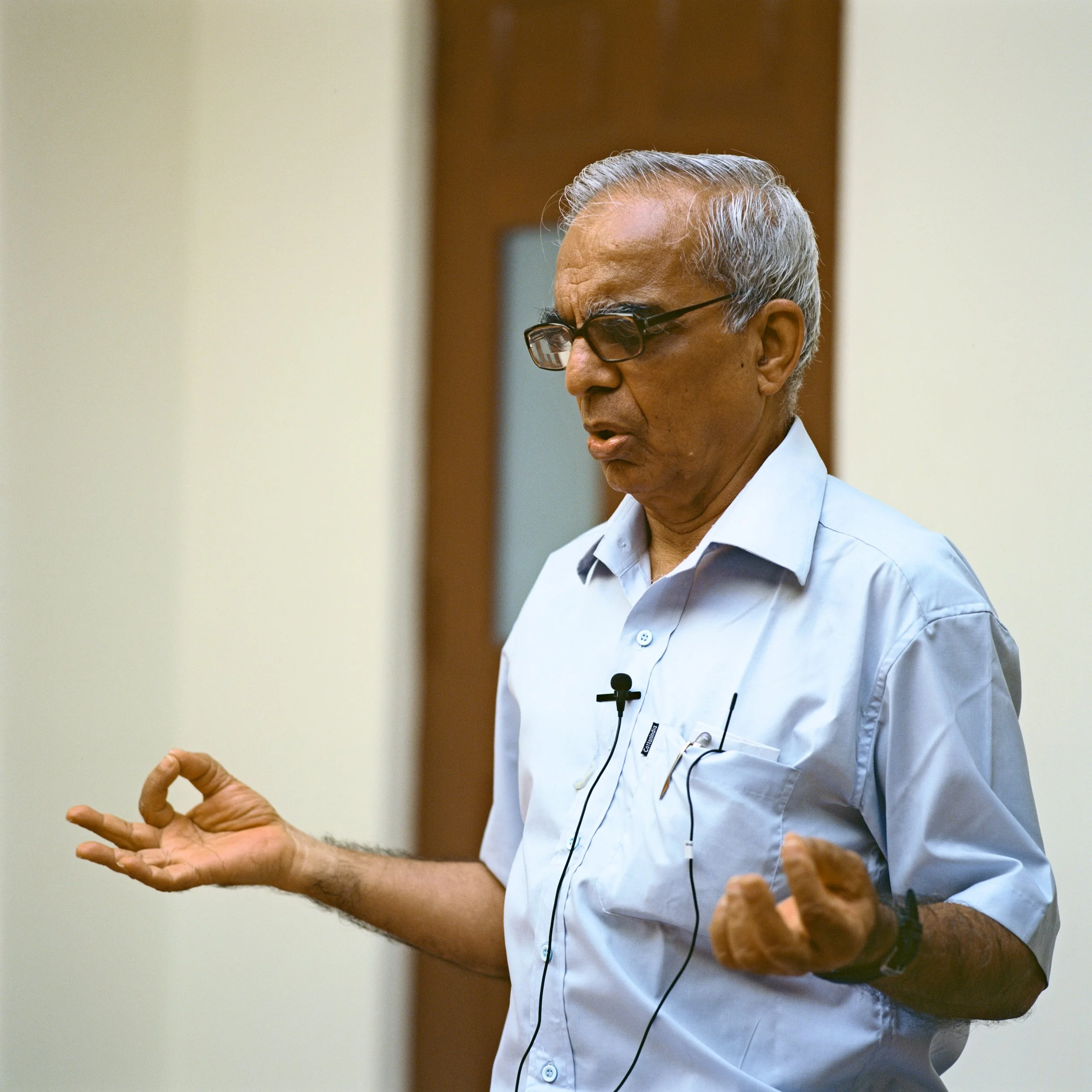
Śrī TKV Desikachar, in a moment of contemplation during teaching
At the heart of TKV Desikachar’s work was a commitment to teaching Yoga in a way that remained true to its original source, while making it meaningful for each individual.
This required holding two essential truths at once — without compromising either. Yoga, as presented by Patañjali, is universal in its principles, addressing the nature of the human mind and the possibility of clarity beyond suffering. These principles are not bound by time, place, or culture. They speak to something fundamental in every human being.
At the same time, no two individuals are the same. Each person arrives with a different body, a different history, different beliefs, and different conditions that shape their experience of life. Even the same individual changes over time — physically, emotionally, and mentally. A practice that is appropriate today may not be appropriate tomorrow.
Desikachar’s contribution lay in honouring both dimensions. Yoga must remain universal in its foundation and personal in its application.
This understanding is expressed through the Viniyoga principle.
Viniyoga is the appropriate adaptation of Yoga’s holistic tools — such as Āsana, Prāṇāyāma, chanting, mantra, and meditation — to meet the needs of the individual. It takes into account differences in age, culture, religion, philosophy, occupation, and the practitioner's physical, emotional, and mental condition. It is not merely modification, but a precise and intelligent application of knowledge.
In this sense, Yoga is not a fixed sequence to be followed, but a living process that must respond to the individual. Through Viniyoga, Yoga becomes something that serves the practitioner, rather than something the practitioner must conform to. This shift — from imposition to adaptation — is what allows Yoga to remain both relevant and transformative.
A Gathering in the Mountains
In a quiet mountain setting in Switzerland, an unusual gathering began to take shape at a time when Yoga was still largely unknown outside India.
Each year, teachers and students from around the world came together for what became known as the Zinal Congress. Over time, it grew into one of the most respected gatherings of Yoga in its era.
The congress was organised by the European Yoga Union, founded by Gérard Blitz — a man whose path into Yoga began far from the world of spiritual practice.
The setting itself was significant. Far removed from Yoga's cultural origins, the congress became a place where teachings were interpreted, adapted, and sometimes misunderstood. It was a meeting point not only for teachers but also for cultures, expectations, and assumptions about what Yoga was — or should be.
The Seeker Behind the Vision
Behind the vision of the Zinal Congress was a seeker whose life had taken an unexpected turn from business to inner inquiry.
Blitz, a Belgian businessman and chairman of Club Med, was drawn toward deeper questions despite his worldly success. A turning point came when he attended a lecture by Jiddu Krishnamurti in Saanen, Switzerland.
The impact was profound. Blitz became a regular attendee of Krishnamurti’s talks, and it was through this connection that he first heard about the teachings of Tirumalai Krishnamacharya.
When he later met Desikachar, who was teaching Krishnamurti in Switzerland, he expressed his wish to study with Krishnamacharya and was invited to come to Chennai.
A Test of Commitment
What followed in Chennai was not a comfortable introduction but a clear test of commitment.
Krishnamacharya asked Blitz to begin his studies in May, the hottest month of the year, and to attend classes at noon, when the heat was at its peak. For a man in his sixties, unaccustomed to such conditions, this was no small challenge.
Yet Blitz did not complain. Day after day, he arrived as instructed and continued his studies.
Desikachar would later recall how much Blitz suffered — particularly from the heat — and yet how he remained steady and sincere.
Only after observing this commitment did Krishnamacharya ease the conditions, allowing him to study at more bearable times. The test had served its purpose.
This episode reflects an important aspect of the tradition: Yoga is not merely something to be learned intellectually, but something that requires dedication, patience, and sincerity.
A Vision Takes Shape
From this period of study, a broader vision for Yoga in the West began to take shape.
Blitz’s dedication deepened to the point that he stepped away from his business responsibilities and devoted himself fully to Yoga. He also studied with Desikachar, forming a close relationship with him.
Recognising the potential for Yoga to reach people beyond India, Blitz founded the European Yoga Union in 1973 to support its growth in Europe.
At the same time, Yoga was beginning to gain visibility internationally, with teachers such as BKS Iyengar, K Pattabhi Jois, Indra Devi, and several students of Swami Sivananda sharing their teachings worldwide.
Blitz decided it was time to organise an event that would gather these extraordinary individuals and present their teachings in a shared space. This marked the beginning of the Zinal Congress. Its purpose was to bring together some of the most respected Yoga masters in one location, where they could share their expertise and experience with one another, and with students from around the world.
The ‘Place to Be’
As this vision matured, the Zinal Congress quickly became the place to be for Yoga practitioners and teachers worldwide.
It brought together a wide range of approaches and created a rare opportunity for dialogue between different traditions. For many attendees, it was their first direct exposure to Yoga.
But it was also a place where differences became visible — not only in techniques, but in understanding.
A Perplexing Observation
During one of these early gatherings, Desikachar made observations that deeply puzzled him.
He noticed that many teachers were using the same practices for all participants, regardless of age, experience, physical ability, or personal needs. The diversity of individuals was being met with uniform instruction, as though Yoga could be reduced to a fixed set of techniques that applied equally to everyone.
He also observed that Yoga was often presented as inseparable from Hindu religious practices, with the implication that adopting these beliefs was necessary for authentic practice.
These observations were not merely technical concerns. They pointed to a deeper misunderstanding of Yoga itself.
What was being presented, in many cases, was not Yoga as a responsive and adaptable discipline, but Yoga as a system — something to be followed rather than applied. The individuality of the practitioner, which lay at the heart of the tradition Desikachar had received, seemed to be missing.
This was not a small deviation. It went to the very core of what Yoga was meant to be.
Returning to the Sūtra-s
When it was time for him to speak, Desikachar chose to return to the Sūtra-s as the foundation of his message.
Setting aside his prepared talk, he addressed what he had observed and drew directly from Patañjali’s teachings. He explained that devotion to a higher principle — Īśvara Praṇidhāna — is offered as one possible tool, but not as a universal requirement.
This distinction is subtle, but essential.
By presenting such practices as optional, Patañjali preserves the universality of Yoga. It allows each individual to approach the practice in a way that is meaningful within their own context, without imposing a belief system that may not resonate with them.
In doing so, Yoga remains open — not only across cultures, but across different ways of understanding life itself.
Desikachar’s point was not to remove spirituality from Yoga, but to restore its inclusiveness. The tools of Yoga must remain available to all, and their use must depend on what is appropriate for the individual.
A Necessary Disruption
This perspective introduced a necessary disruption to the prevailing assumptions at the congress.
Many teachers were uncomfortable with his position and believed that Yoga should remain closely tied to Hindu traditions. His words challenged that view and created tension.
Yet this disruption was not an act of opposition, but of clarification. It was an attempt to bring the understanding of Yoga back to its roots. And that it was as applicable to those who believed in Hindu culture, as it was to those who were alien to it.
For many students, particularly those from different cultural backgrounds, his message was deeply reassuring.
For the first time, they heard that Yoga could meet them where they were, without requiring them to adopt beliefs foreign to their own lives. It opened the possibility of engaging with Yoga in an authentic way, without conflict or compromise. Later, many would reinforce their commitment to their faith through Yoga's inclusive practices.
The Individual at the Centre
Beyond the question of religion, Desikachar brought the focus back to the individual as the true centre of Yoga practice.
He emphasised that, in the classical tradition, Yoga was taught one-to-one, with careful observation of the student as a whole person — not only physically, but mentally and emotionally.
This was not simply a matter of adjusting posture or intensity. It required understanding the individual’s condition, tendencies, challenges, and aspirations. Only then could the appropriate tools be selected.
Each practice was then adapted to the individual’s condition, needs, and context. This was not a secondary feature of Yoga, but a defining one.
To teach everyone in the same way, regardless of their differences, was not only ineffective — it was contrary to the very principles on which Yoga was based.
The Meaning of Viniyoga
This approach is best understood through the meaning of Viniyoga — the principle of appropriate application.
Viniyoga recognises that the tools of Yoga are not ends in themselves, but must be used in a way that is relevant and beneficial to the individual.
It asks not “What is the correct practice?” but “What is the appropriate practice for this person, at this time?”
This shift in perspective is fundamental.
It requires the teacher to observe, to listen, and to adapt. It requires the practitioner to engage with awareness, rather than imitation. It transforms Yoga from a system of repetition into a process of understanding.
What is helpful for one individual may not be helpful for another. What supports someone at one stage of life may need to change as circumstances evolve.
Without this sensitivity, Yoga risks becoming rigid and mechanical. With it, Yoga remains responsive, effective, and alive.
In this sense, Viniyoga is not simply a method within Yoga — it is the means by which Yoga retains its relevance.
Universal. And Personal.
What emerged from Desikachar’s presence at Zinal was a clear articulation of a timeless principle: Yoga is both universal and personal.
Its principles are universal, grounded in an understanding of the human condition. They do not belong to any one culture, tradition, or belief system.
Its application, however, must always be personal, shaped by the individual.
To emphasize only the universal is to risk abstraction. To emphasise only the personal is to lose direction. It is in holding both together that Yoga becomes meaningful.
This balance — between what is shared and what is unique — is what allows Yoga to remain both accessible and effective.
This is the essence of Viniyoga — and it is through this understanding that Yoga continues to remain meaningful, relevant, and alive.
A Living Legacy
What Desikachar articulated at Zinal was not simply a response to a particular moment, but a reaffirmation of a principle that continues to shape the teaching of Yoga today.
The understanding that Yoga must be both universal in its foundation and personal in its application did not remain confined to those early gatherings. It became a guiding thread carried forward by his students across the world, many of whom continue to teach in the spirit of Viniyoga — adapting practices carefully to the needs of each individual.
In this way, the essence of his teaching remains alive, not as a fixed system, but as a living approach that evolves with each person it touches.
This continuity is also reflected within his own family. Dr Kausthub Desikachar, his son and successor, continues to share and develop these teachings, bringing them into contemporary contexts while preserving their integrity.
Through this ongoing work, the principle of Viniyoga continues to reach new individuals in new contexts, while remaining rooted in its original intent.
What emerges from this transmission is not a single method, but a way of understanding Yoga itself — one that does not impose, but responds; does not standardise, but adapts; and remains grounded in timeless principles while meeting each individual exactly where they are.
In this sense, Yoga as both universal and personal is not only a teaching — it is a living legacy.
This article was first published in the Yoga Magazine UK in the May 2026 edition. To download the artcle as a pdf click here>