
Simply Being Human!The quiet greatness and compassionate teaching of TKV Desikachar
by Dr Kausthub Desikachar, PhD
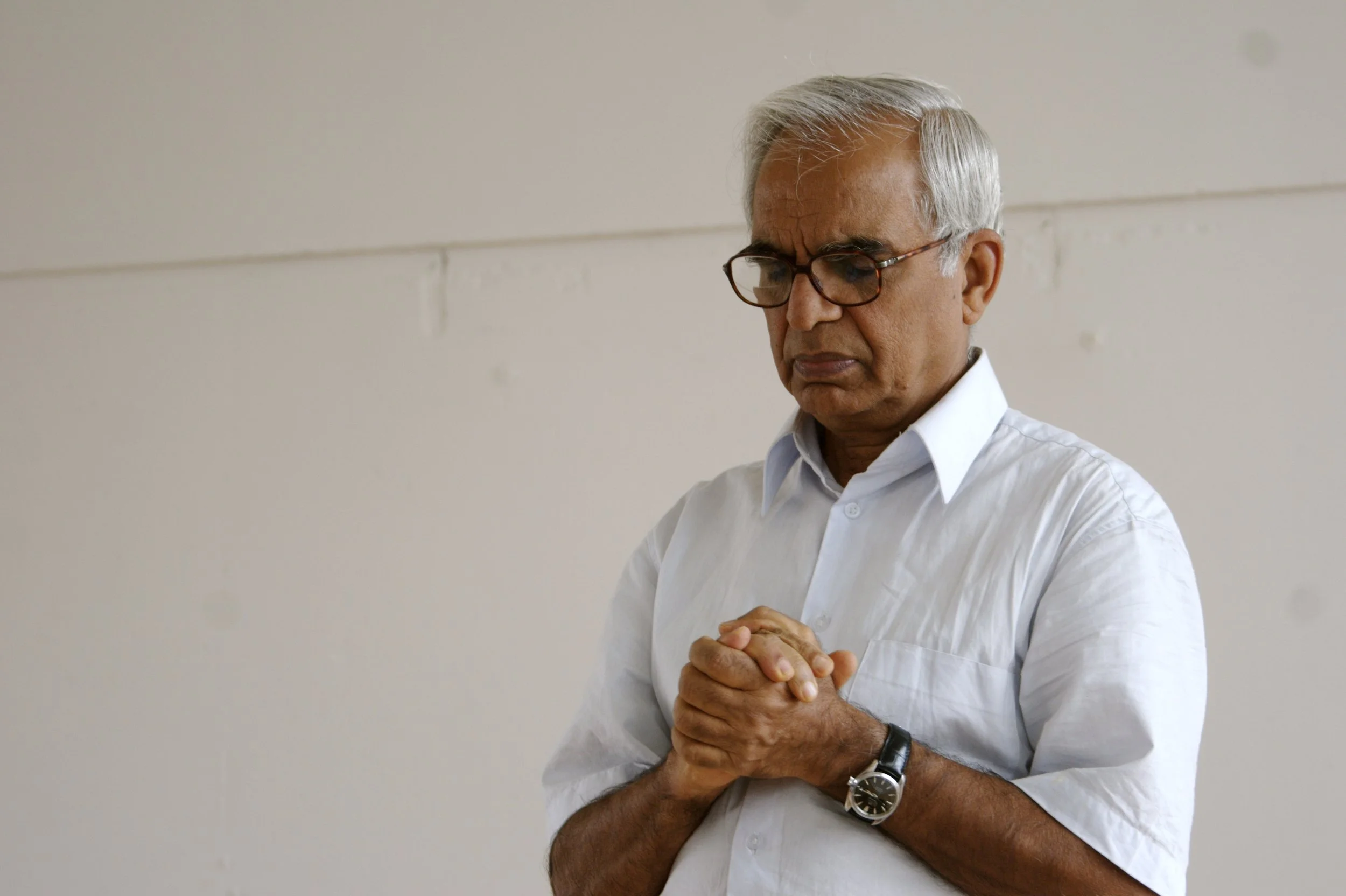
Śrī TKV Desikachar, in a moment of contemplation during teaching
Over the course of more than fifty years of teaching, TKV Desikachar quietly shaped the lives of thousands of people across the world. Students came from different cultures, professions, and spiritual backgrounds. Some arrived as seekers, others as patients seeking relief from illness, and still others as teachers seeking to deepen their understanding of Yoga.
What united them was a simple but powerful experience: being met exactly where they were.
To each student, Desikachar became the teacher they needed. His genius lay not merely in his knowledge of Yoga but in his remarkable ability to read the person sitting in front of him. He understood their temperament, fears, strengths, and aspirations. From that understanding, he would adapt everything — the practices, the pacing, the explanations, and even the tone of his voice.
For Desikachar, Yoga was never something rigid or standardised. It was always personal.
The practice had to fit the individual, not the other way around.
This principle reflects the true spirit of Viniyoga, rooted in the teachings of Patañjali — the understanding that Yoga must always be adapted to the individual according to their condition, stage of life, and unique needs.
This approach reflected the teachings he received from his father and guru, Tirumalai Krishnamacharya, who often emphasised that the heart of Yoga lies in its adaptability. Desikachar embodied this principle so completely that students often felt as though the teachings had been created specifically for them.
In truth, they had.
The Teacher Everyone Saw Differently
One of the fascinating aspects of Desikachar’s personality was how differently students experienced him.
Ask a group of his students to describe him, and the answers could sound as if they were speaking about completely different people.
Some would say he was extremely strict.
Others remembered him as gentle and kind.
Some described his sense of humour and playful wit.
Others spoke of his penetrating seriousness.
All of these descriptions were true.
Desikachar had a rare ability to sense which role he needed to play to help a student grow. If discipline was required, he could be firm. If encouragement was needed, he could be compassionate and supportive. If a student was overly serious, he might lighten the atmosphere with a well-timed joke.
In this way, he mirrored the student's needs.
Yet this also meant that most students never fully knew the man behind the teacher. What they experienced was often the aspect of Desikachar that he felt would best serve their growth. Each student saw a genuine part of him, but rarely the whole.
Only those closest to him — intimate family members and a small inner circle — witnessed the full breadth of his personality. Among them was his son and successor, Kausthub Desikachar, who had the rare privilege of seeing both the public teacher and the private man.
To the world, he appeared to be a simple, approachable Yoga teacher. To those who truly knew him, however, he was something more — a quiet yet profound master whose depth revealed itself gradually over time.
This capacity did not come from strategy or technique. It arose naturally from a deep attentiveness to the human being in front of him. He listened carefully, observed quietly, and responded with sensitivity.
Many students later realised that what they had experienced was not simply good teaching — it was profound empathy.
Teaching the Famous — and the Unknown
Over the decades, Desikachar taught a remarkable range of people.
Politicians, artists, scientists, doctors, business leaders, athletes, and movie stars all sought his guidance. Some came out of curiosity, others out of admiration for the lineage of Yoga he represented. Many arrived because they had heard that he possessed extraordinary skill in the therapeutic application of Yoga.
For them, Yoga was not merely an exercise or philosophy.
It was healing.
Yet Desikachar never treated fame as something particularly significant. To him, the essential fact about any student was not their public identity but their humanity.
When asked about his well-known students, he often responded with characteristic simplicity:
“They are special people, no doubt — yet they are also as human as you and I.”
That sentence revealed a great deal about him. Fame, influence, or status never distracted him from seeing the person behind the public image. In his presence, people who were constantly admired, criticized, or scrutinised by the world found something rare — the freedom to simply be themselves.
One of his students once described this quality beautifully. The student was a very famous movie star in India, someone whose life unfolded constantly under the public's and the media's gaze.
Speaking about his experience with Desikachar, he reflected:
“The world around me treats me like I am God, which makes me uncomfortable, as every move I make is being watched and judged. Sir reminds me that I am human, and I feel so comfortable in his presence.”
In Desikachar’s presence, titles, fame, and public image seemed to fall away. What remained was simply the person.
This was perhaps one of his greatest gifts.
He helped people return to their humanity.
A Meeting That Began a Friendship
Among the many notable figures who studied with Desikachar, one relationship stands out for its depth and duration — his association with the renowned philosopher Jiddu Krishnamurti.
The two men developed not only a teacher-student relationship but also a genuine friendship that lasted until Krishnamurti’s death in 1986.
Their story began on a quiet December morning in 1964.
A man arrived at the home of Krishnamacharya in Chennai and introduced himself as Krishnamurti’s secretary. He explained that Krishnamurti wished to meet with the great Yoga master and discuss the possibility of becoming his student.
Krishnamacharya agreed to the meeting.
He suggested they gather at Vasant Vihar, the headquarters of the Krishnamurti Foundation of India and the place where Krishnamurti stayed whenever he visited Chennai.
Krishnamacharya also mentioned that he would bring two of his sons with him.
Demonstrating Yoga
At that time, Krishnamurti had already been practicing Yoga for many years. His teacher had been B. K. S. Iyengar, one of Krishnamacharya’s most famous students.
Krishnamurti was well-versed in many āsana-s and was known for maintaining a disciplined practice. However, he was approaching seventy and had begun to experience several health concerns. He had heard that Krishnamacharya possessed remarkable healing skills and wanted to explore whether Yoga therapy could help him.
The following day, Krishnamacharya arrived at Vasant Vihar accompanied by Desikachar and his younger brother, TK Sribhashyam.
Krishnamurti welcomed them warmly.
Curious to see the Yoga tradition represented by Krishnamacharya, he asked for a demonstration of the practices. Krishnamacharya invited his two sons to demonstrate various āsana-s and prāṇāyāma techniques.
Krishnamurti watched carefully.
He was deeply impressed by what he saw.
Choosing the Teacher
After the demonstration, Krishnamurti expressed his desire to study with Krishnamacharya. However, because of his age and his demanding international travel schedule, he explained that it might be difficult for Krishnamacharya himself to teach him regularly.
He then added something unexpected.
If one of Krishnamacharya’s sons were willing to teach him, he would gladly accept that arrangement.
Krishnamacharya considered the request.
Then he made a decision that would shape Desikachar’s life.
He asked Desikachar to become Krishnamurti’s teacher.
In many ways, this was a classic move by the wise master Tirumalai Krishnamacharya. He was not only testing the faith and sincerity of Jiddu Krishnamurti, but also creating an important opportunity for his son.
By asking Desikachar to guide such a distinguished student, Krishnamacharya was quietly establishing a platform of responsibility and mentorship. Desikachar would work diligently with Krishnamurti while continuing to receive guidance and instructions from his own father.
In this way, the arrangement benefited everyone involved. Krishnamurti received attentive, consistent guidance, while Desikachar gained invaluable experience as a teacher under his guru's watchful eye.
In retrospect, this moment also marked an important turning point. Through this relationship, Desikachar gradually began to emerge from his illustrious father's shadow and step into his own role as a teacher — one who would eventually carry his father’s living tradition to the wider world.
It was, in every sense, a win–win situation for both Krishnamurti and Desikachar.
A Relationship That Spanned Continents
From that point onward, Desikachar and Krishnamurti worked together regularly. Their sessions included Yoga practices adapted to Krishnamurti’s health needs, along with thoughtful discussions about philosophy, awareness, and the role of discipline in spiritual life.
Their collaboration extended beyond India.
In fact, the first time Desikachar ever travelled abroad was to visit Krishnamurti in Switzerland. The journey marked the beginning of Desikachar’s international teaching work, which would later expand across Europe, the United States, and many other countries.
Through Krishnamurti, Desikachar encountered a circle of extraordinary thinkers, artists, and spiritual explorers who gathered around the philosopher’s work. Many of them were curious about Yoga and eager to learn from the young teacher who represented the living tradition of Krishnamacharya.
Several of these individuals would go on to become influential figures in the modern history of Yoga.
Influential Students
One such student was Rukmini Devi Arundale, the legendary dancer who founded the renowned Kalakshetra Foundation.
Rukmini Devi’s contributions to Indian classical dance were monumental. Yet despite her fame and cultural influence, she approached the study of Yoga with humility and dedication. Under Desikachar’s guidance, she explored how Yogic practices could support both physical vitality and inner clarity.
Another important student was Gerard Blitz. Blitz became deeply interested in Yoga philosophy and practice and later played a significant role in introducing Yoga to Western audiences.
Also among Desikachar’s students was Vanda Scaravelli, who later became one of the most respected Yoga teachers in Europe. Scaravelli’s teachings emphasised sensitivity, gravity, and natural movement — principles that resonated strongly with the personalised approach she experienced while studying with Desikachar.
These individuals, and many others like them, helped carry aspects of Desikachar’s teaching into different parts of the world.
Healing Through Yoga
Although Desikachar’s students included philosophers, artists, and cultural leaders, many people came to him for a much more immediate reason.
They were suffering.
Some struggled with chronic illness. Others faced physical injuries, respiratory problems, or psychological distress. Many had exhausted conventional medical treatments and were searching for another path to healing.
Desikachar approached these situations with great care.
He would first spend time listening to the person’s story — not just their symptoms, but their lifestyle, emotional state, and daily habits. Only after understanding the whole person would he design a sequence of practices tailored to their needs.
These practices might include gentle āsana movements, specific breathing techniques, chanting, meditation, or lifestyle adjustments.
In this way, Yoga became a form of therapy.
This therapeutic application of Yoga would later become one of Desikachar’s most important contributions to the modern Yoga world. By carefully adapting the tools of Yoga to the needs of each individual, he demonstrated in practical terms what the tradition of Viniyoga teaches — that the purpose of Yoga is to serve the person, supporting health, clarity, and inner balance.
For many patients, the results were profound. Pain diminished, breathing improved, and mental clarity returned. Yet Desikachar always emphasised that the real power of Yoga was not merely in curing illness.
It was in helping a person rediscover balance.
The Simplicity of Being Human
Despite the extraordinary range of people he taught and the global recognition he eventually received, TKV Desikachar remained remarkably simple in his outlook.
He never cultivated an image of spiritual grandeur. He did not present himself as a guru surrounded by mystique. Instead, he preferred to meet people in an atmosphere of normalcy and warmth.
Conversations with him often felt less like formal instruction and more like thoughtful dialogue.
He listened more than he spoke.
He encouraged questions.
And he frequently reminded students that the purpose of Yoga was not to escape life but to live it more skillfully.
This grounded perspective revealed a fundamental aspect of his character. Desikachar understood that behind every role — teacher, student, celebrity, patient, philosopher — there was simply a human being trying to navigate life.
Yoga, in his view, existed to support that journey.
And perhaps that is why so many people, regardless of their background or beliefs, felt comfortable in his presence.
They were not expected to become something extraordinary.
They were simply invited to be human.
Yet behind this simplicity lived a depth that only a few ever truly witnessed. Most students encountered the teacher who appeared before them in that moment — strict or gentle, humorous or serious, philosophical or practical — the aspect that would best support their growth.
Only those closest to him experienced the full richness of his personality: the father, the friend, the quiet observer, and the master teacher all at once.
Among those who knew him in this complete way was his son and successor, Kausthub Desikachar.
To the wider world, he appeared simply as a humble Yoga teacher from Chennai.
But to those who truly came to know him, he revealed himself as something rare — a master whose greatness expressed itself not through display, but through the profound simplicity of being fully human.
This article was first published in the Yoga Magazine UK in the April 2026 edition. To download the artcle as a pdf click here>