
The Son is Shining! From Student to Steward of a Living Tradition
by Dr Kausthub Desikachar, PhD
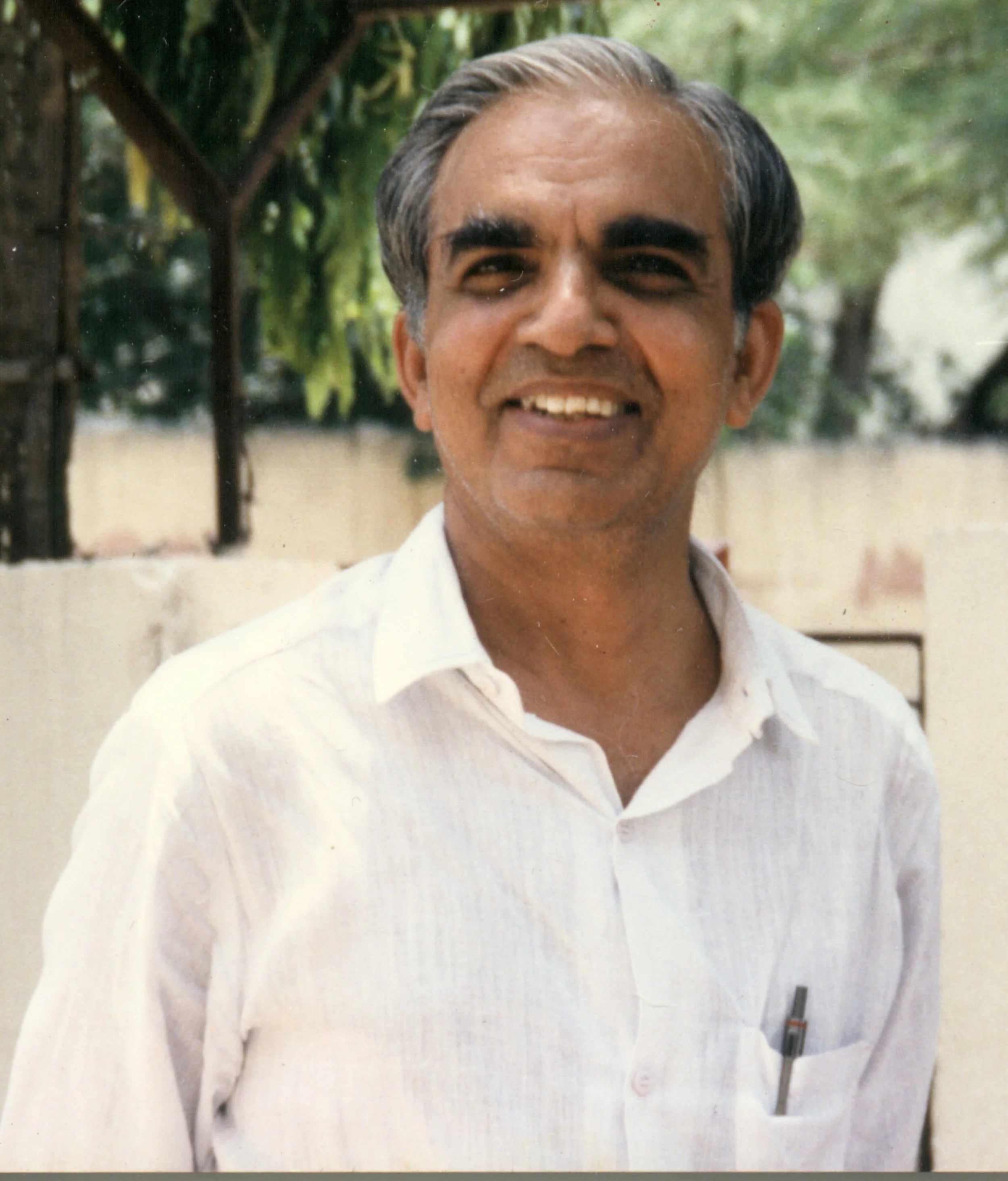
A Young TKV Desikachar, at his home!
The Making of a Successor: Training, Transmission, and Timing
When T.K.V. Desikachar sensed that Yoga would no longer remain a peripheral presence in his life, it was not through a dramatic calling or a sudden awakening. It emerged quietly, through responsibility rather than romance. With a young family to support, Desikachar took a part-time job at a construction company in Chennai, dedicating his working hours to earning a livelihood while devoting the remainder of his time to studying Yoga under his father. This balance between worldly obligation and inner inquiry would become one of the defining rhythms of his life—and later, of his teaching.
Unlike many who approached Yoga seeking liberation from worldly duties, Desikachar entered Yoga while fully immersed in them. This grounding proved significant. His father, Tirumalai Krishnamacharya, did not rush him into physical practice or technical mastery. Instead, the first phase of Desikachar’s training was textual and contemplative. Classical Yoga and philosophical texts had to be memorised, recited, and absorbed before āsana, prāṇāyāma, meditation, or therapeutic application were explored in depth. This sequence was deliberate. Krishnamacharya wanted his son to understand that Yoga was not a collection of techniques, but a living expression of an ancient vision—one that demanded humility, patience, and reverence.
As Desikachar studied more closely with his father, a realisation dawned on him: the deeper he went, the more vast his father’s knowledge revealed itself to be. What initially seemed like familiarity—after all, he had grown up surrounded by Yoga—slowly transformed into awe. The distance between what he knew and what remained to be learned did not shrink; it expanded. This was not discouraging. It was sobering. It reshaped his attitude from casual proximity to serious discipleship.
A Successor in the Making
Krishnamacharya did not train all his students in the same way. Many received principles, practices, and frameworks appropriate to their roles as practitioners or teachers. But with Desikachar, the approach was markedly different. Krishnamacharya saw in his son not merely a capable student, but a potential carrier of the lineage. This recognition brought with it a different level of rigour, intimacy, and responsibility.
Desikachar was trained more stringently than others, not out of favouritism, but out of necessity. Krishnamacharya shared with him teachings that were not given elsewhere—subtle principles, deeper integrations, and guarded insights that required not only intellectual understanding, but moral steadiness and emotional maturity. These were not secrets meant to create hierarchy; they were entrusted because they demanded careful timing and discernment.
This is an important reason why Desikachar’s teachings differ markedly from those of other renowned students of Krishnamacharya, such as BKS Iyengar, Pattabhi Jois, or Indra Devi. While they were short-term students of the grandmaster, Desikachar was not only the student with the longest tenure, but also chosen for specialised training, as he was seen as the one who would carry on the lineage.
This choice did not elevate Desikachar above others; it bound him more tightly to the discipline of the tradition. To be chosen as a successor was not a mark of achievement, but an acceptance of obligation and great responsibility. It required him to listen longer, speak less, and submit himself repeatedly to correction. In this way, lineage was not something he inherited by birth or proximity, but something he had to earn through endurance and trust.
Krishnamacharya understood something that history has repeatedly confirmed: the world is not always ready for the deepest dimensions of a teaching. To reveal everything prematurely is not generosity—it is negligence. He therefore passed these teachings to Desikachar, aware that they might not be fully expressed in his own lifetime, or even in Desikachar’s. The task was not to disseminate, but to preserve, embody, and protect.
In this sense, Desikachar’s training was shaped as much by restraint as by instruction. He learned not only what to teach, but when not to teach. This sensitivity to context would later become one of the hallmarks of his approach.
Learning Beyond the Classroom
Desikachar’s education did not unfold primarily in formal classes. Some of the most formative lessons occurred in everyday settings—in travel, in healing encounters, in quiet observation. Krishnamacharya often took his son along as an intern to the many classes he taught. Desikachar would watch his father apply the same principles to individuals of vastly different ages, health, and levels of scepticism and devotion. No two lessons were the same, yet none violated the integrity of the tradition.
Equally important was the supervision Krishnamacharya provided when Desikachar himself began to teach. This close proximity was unique. Other students eventually moved away or taught independently. Desikachar remained physically and relationally close to his teacher—not only because he was his son, but because he was being shaped through constant correction, dialogue, and refinement. Teaching was not a declaration of readiness; it was an extension of learning.
This closeness also exposed Desikachar to his father’s moments of doubt, adjustment, and quiet reflection. He saw that mastery did not mean certainty, but responsiveness. Despite his greatness, Krishnamacharya remained human—subject to trials, tribulations, and even flaws like any other. Yet these did not diminish his credibility; they enhanced it, revealing a teacher whose authority arose not from perfection, but from sincerity and lived inquiry. Krishnamacharya was faithful to principles while remaining flexible in their application, and observing this living adaptability would later become one of Desikachar’s most defining insights as a teacher.
The Lesson That Changed Everything
One incident from this period would later stand out in Desikachar’s memory as a turning point. Overworked and overwhelmed, he once planned an evening escape to the movies with friends. Just before closing time, his boss asked him to stay late and complete an important task. Wanting desperately to leave, Desikachar improvised an excuse: he claimed he had committed to teaching a Yoga class that evening. The lie worked, and he left—relieved, if uneasy.
The following day, his boss summoned him. Expecting reprimand, Desikachar entered the office with guilt and apprehension. Instead, his boss greeted him warmly and said, “Tonight, I want you to teach me Yoga.”
Caught in his own fabrication, Desikachar had no choice but to agree.
That evening, his boss accompanied him home. It was Desikachar’s first time teaching anyone, and he had no framework, no plan, no understanding of adaptation. He simply taught his own practice. Within minutes, the man was panting. Shortly after, he collapsed.
Panicked, Desikachar rushed to his father and confessed everything. Krishnamacharya immediately attended to the man, stabilising him with calm efficiency. When the situation was under control, he turned to his son and delivered what Desikachar would later describe as the most important lesson he ever received: “Don’t ever assume that what works for you will work for everyone else. Yoga must be tailored to suit the student, not the other way around.”
Then he added quietly, “And from now on, consult me before you teach anyone.”
This was not a rebuke—it was an initiation. From that day onward, Desikachar’s relationship with his father took on a new dimension. Teaching was no longer accidental. It became a supervised apprenticeship, grounded in responsibility and humility. This dynamic continued until Krishnamacharya’s death in 1989, and even afterwards, Desikachar would say that he continued to consult his father inwardly, guided by the principles and standards he had absorbed.
Initiation into the Heart of the Paramparā
Among all that Desikachar received from his father, one transmission stood apart in its depth and symbolism. Krishnamacharya initiated him into a secret mantra of the paramparā, a sacred sound formula that served as a spiritual anchor and a means of inner alignment while transmitting the teachings.
This mantra was dedicated to Śrī Hayagrīva, an incarnation of Srī Viṣṇu associated with the preservation and restoration of the Vedas. According to tradition, Śrī Hayagrīva battled two demons who had stolen the sacred knowledge, plunging the world into darkness. The myth is not merely cosmological; it is profoundly psychological and ethical. To restore wisdom, one must overcome two forces: the inner demons, such as ego, fear, and distortion, and the outer demons, such as distractions, projections or expectations from others.
The mantra itself is ancient and guarded. It is not widely taught, nor is it intended for general practice. It is shared only with those who are entrusted with carrying the lineage forward—those who bear the weight of preservation, not performance. This initiation was given by Krishnamacharya to Desikachar alone. Later, Desikachar would perform the same initiation with his own son and successor, Kausthub Desikachar, continuing the unbroken chain of transmission.
This act encapsulates the essence of traditional Yoga teaching: knowledge is not owned, it is held in trust.
The Burden of Timing
Despite his extensive training and intimate access to the core teachings, Desikachar did not rush to present them to the world. In many ways, he carried more than he could openly express. Krishnamacharya’s intuition proved accurate—the cultural and spiritual climate of Desikachar’s lifetime was still not fully receptive to the deepest dimensions of Yoga as a holistic, integrated, and spiritually grounded path.
Rather than forcing relevance, Desikachar practised restraint. He taught what could be received. He emphasised adaptation, individualisation, and practical application—not as compromises, but as compassionate bridges. The deeper teachings remained alive within him, shaping his discernment, even when they were not articulated explicitly.
This restraint was not born of hesitation or fear, but of discernment. It was also shaped by historical circumstance. India was only just emerging from British occupation, and relations with the West were still marked by uncertainty and a lack of mutual trust. In this climate, many Indian teachers were understandably cautious about sharing the full depth of their traditions with foreign students.
At the same time, in the early years of Desikachar’s teaching, there were relatively few Indian students seeking systematic study of Yoga.
These conditions further reinforced the necessity of restraint, discretion, and careful transmission. Desikachar understood that teachings revealed before they are ready to be received often become distorted, reduced, or misused. Silence, in this sense, was not absence, but protection. By holding certain dimensions of the tradition inwardly, he ensured that when they were eventually expressed, they would emerge intact rather than compromised.
To some of his long-term students, he would say, “I have taught all that I can. There is nothing more for you to learn.” They interpreted it as if they had learnt the whole tradition and all that Desikachar knew. Far from it! Desikachar taught only what he concluded they could absorb, and he did not waste his time on what they could not comprehend.
Quietly, humbly, the lineage continued. Kausthub Desikachar would later take on the responsibility of carrying these teachings forward in his own understated manner, attentive to the same question that guided his predecessors: Is the time right?
A Chapter of Preparation
This part of Desikachar’s journey is not about acclaim or expansion. It is about formation. It is about learning to wait, listen, adapt, and serve. It is about receiving teachings not as privileges, but as obligations—obligations to integrity, timing, and humanity.
By the time Desikachar emerged as one of the most influential interpreters of Yoga in the modern world, the foundation had already been laid in silence, supervision, and sacred trust. What he offered outwardly was shaped by decades of inward preparation.
The story does not end here. But it pauses—deliberately—at a place of stillness, where knowledge is held gently, and the future is approached with humility rather than urgency.
In an era increasingly dominated by loud voices, charismatic influencers, and internationally celebrated spiritual figures, this chapter of Desikachar’s life offers a quiet but necessary reminder. Enduring greatness is rarely built on eloquence alone or on the ability to capture attention. More often, it is forged in silence, discipline, and a willingness to remain unseen. What ultimately matters is not who becomes the most famous master but whose teachings can be sustained, transmitted with integrity, and adapted without losing their essence. Desikachar’s formation reminds us that Yoga survives not through spectacle, but through silent and exemplary stewardship.
In the articles that follow, this quiet preparation will begin to bear visible fruit. Future chapters will highlight some of Desikachar’s most significant and far-reaching contributions to the field of Yoga—his clarity of vision, his insistence on individualised teaching, and his profound impact on how Yoga came to be understood and practised across cultures. Yet all of those contributions are rooted here, in this period of restraint, transmission, and careful timing.
This article was first published in the Yoga Magazine UK in the March 2026 edition. To download the artcle as a pdf click here>