
Drawn to Remember
How Desikachar’s Stick Figures Bridged Tradition and Innovation
by Dr Kausthub Desikachar, PhD
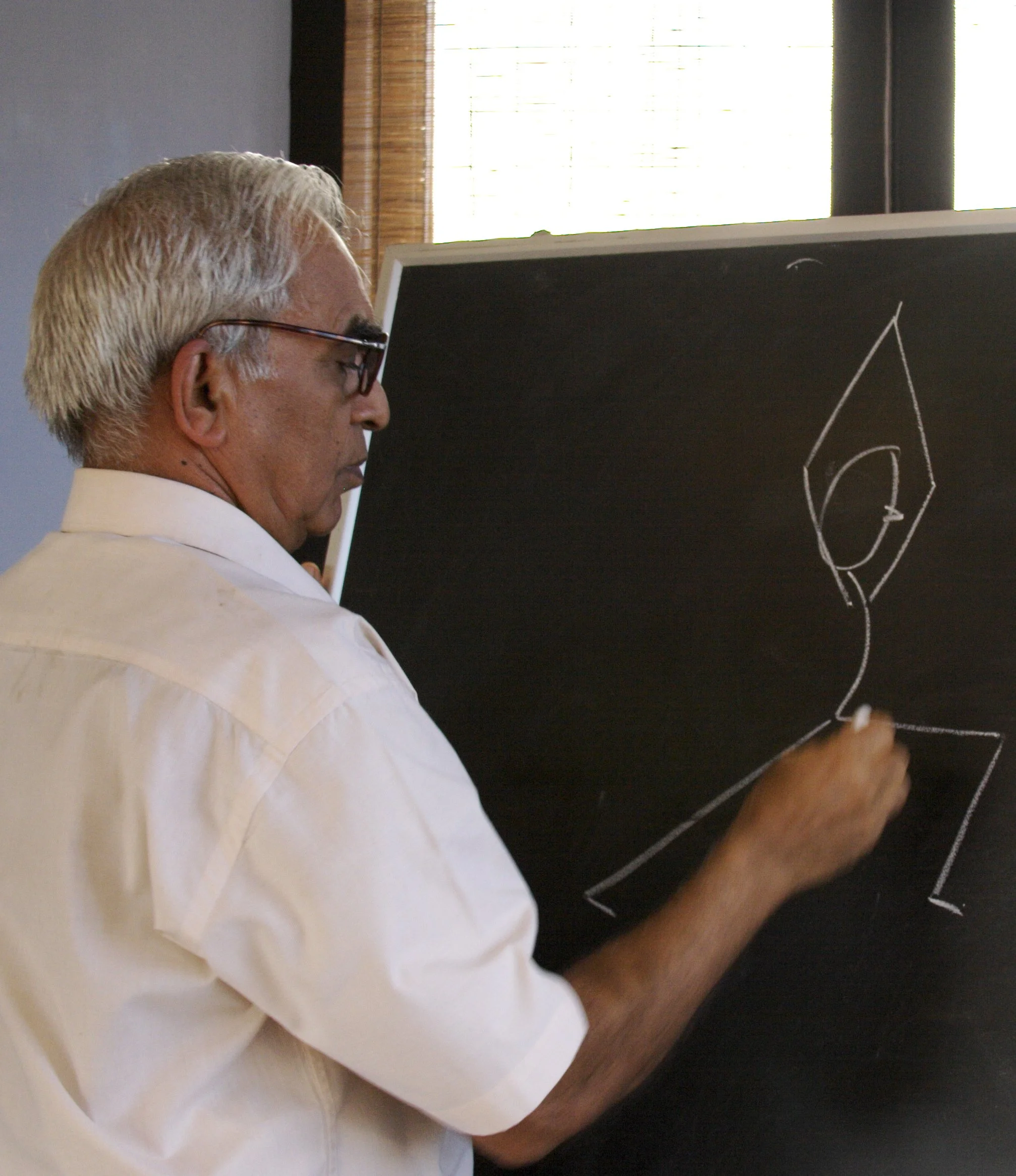
Śrī TKV Desikachar, using his innovative stick figures to teach students!
A Ridiculed Idea
“Are you teaching technical drawing or Yoga?” mocked one of Desikachar’s colleagues when he first saw Desikachar’s stick figures. “This is not going to work. People are not going to like it, understand it, or use it. You are wasting your time.”
Faced with criticism, many might have abandoned the idea. However, Desikachar’s unwavering resolve marked a turning point. He quietly persevered, refining what would become an influential educational tool in modern Yoga. What began as a peculiar experiment soon reshaped how Yoga practices were remembered, transmitted, and taught worldwide.
Desikachar’s motivation did not stem from a desire to modernise Yoga for novelty's sake. It came from a very practical observation. Again and again, he noticed that students struggled to remember the practices that he or his father had carefully prescribed for them. Even sincere students who attended regularly would return confused about the exact order of postures, the positioning of the limbs, the breathing ratios, or the variations specifically adapted for them.
“Too much information!” or “Too much to remember!” students would often exclaim.
The Problem of Remembering Practice
This challenge became especially evident because the Viniyoga approach emphasised individualised practice. Unlike rigid group systems in which everyone repeated the same sequence, Desikachar and Krishnamacharya often adapted practices to each individual student's needs, age, health, profession, lifestyle, and goals. As a result, students frequently left class with unique, highly specific sequences designed for them. Remembering every detail purely through verbal explanation was not always easy.
Desikachar also realised that describing a single posture verbally could sometimes require many sentences. A teacher might spend several minutes explaining what could be communicated visually within seconds. And the student would have even more difficulty remembering all those instructions. He began to feel that there had to be a simpler and more efficient way to support learning.
His engineering background deeply influenced the way he approached this problem. Before dedicating himself fully to Yoga, Desikachar had trained and worked as a civil engineer. Engineering taught him to think systematically, efficiently, and functionally. In technical fields, drawings and diagrams were used to quickly and clearly communicate complex three-dimensional information. A well-designed visual representation could reduce confusion and eliminate unnecessary explanation.
Desikachar began wondering whether Yoga could also benefit from such simplicity.
An Engineer’s Vision
This insight eventually inspired him to create what are now universally recognised as Yoga stick figures.
The idea itself may appear deceptively simple today, but at the time it was revolutionary. In an era before digital media, smartphones, online videos, or instant photography, students largely depended on memory, written notes, or repeated teacher contact to maintain their home practice. Desikachar envisioned something radically practical: a visual language that could help students remember their practices accurately and independently.
In many ways, this reflected the precision of an engineer’s mind applied to the teaching of Yoga. He was not only concerned with transmitting knowledge, but also with how knowledge could be retained. He understood that even the best teaching becomes ineffective if the student cannot sustain the practice once they leave the teacher’s presence.
The stick figures, therefore, emerged not as artistic decoration but as a carefully designed educational tool.
Much like lines of code quietly shaping a digital program, Desikachar’s stick figures carried precise instructions beneath their simplicity, guiding the practitioner through movement, breath, and inner experience.
The Collaboration with Menaka
His wife, Menaka, played an important role in this process. Gifted artistically and naturally skilled at drawing, she collaborated closely with him to develop the early forms of the figures. Together, they experimented with different visual styles and proportions, searching for a way to communicate movement and posture with the greatest clarity and the least complexity.
The process was not immediate. It took some years of experimentation before the drawings evolved into the familiar forms that later became standardised. The challenge was not merely artistic. The figures had to be simple enough for anyone to understand, yet precise enough to communicate important details of movement, direction, positioning, and sequencing.
This collaboration also reflects something beautiful about how traditions quietly evolve. Often, important contributions emerge not through grand public declarations but through intimate collaboration, experimentation, and patient refinement behind closed doors.
Resistance from Traditional Circles
At first, many people found the drawings awkward or unusual. Some students were uncertain how to interpret them. Others simply could not imagine that such minimalistic sketches could become useful educational tools. Among more traditional practitioners, scepticism was even stronger.
Certain critics feared that the stick figures represented an attempt to replace the ancient oral tradition of Yoga with modern diagrams and written systems. For those deeply attached to traditional modes of transmission, the idea felt unsettling. Yoga had historically been passed directly from teacher to student through observation, repetition, correction, and memory. The concern was that visual aids might reduce the sacredness or depth of the teaching process.
But this misunderstanding never reflected Desikachar’s actual intention.
He did not seek to replace oral transmission, nor did he believe that drawings alone could teach Yoga. The stick figures were never intended to substitute for a teacher's living presence. Rather, they were designed to support students after they left the classroom. Their purpose was practical and compassionate: to help people remember correctly what had already been taught personally.
Supporting the Student’s Independence
Desikachar understood that true transformation in Yoga came not merely from attending classes, but from consistent home practice. If students forgot their sequences or practised incorrectly after returning home, much of the value of individualised teaching could be lost. The stick figures became a bridge between the teacher’s instruction and the student’s independent daily practice.
In many ways, the stick figures themselves reflected one of the deepest principles of Viniyoga: adaptation.
Just as practices were adapted to the individual, Desikachar adapted the teaching method itself to better serve modern students. He recognised that contemporary life placed increasing demands on memory, attention, and time. Rather than insisting that students conform to older methods regardless of difficulty, he searched for ways to remove obstacles without compromising the integrity of the teaching.
This practical spirit was something he had inherited directly from his father and teacher, Krishnamacharya.
Contrary to popular assumptions, Krishnamacharya was not opposed to innovation. What mattered to him was whether a change preserved Yoga's function and purpose, and, most importantly, its pure essence. If an innovation genuinely helped students while maintaining the integrity of the teaching, he welcomed it. When he saw the usefulness of Desikachar’s project, he approved of it and gave his blessings.
This approval carried deep significance. It demonstrated that the tradition was not frozen in time, but alive and responsive. The survival of any authentic tradition depends not on rigid preservation of outer forms alone, but on the intelligent preservation of essential principles.
From Experiment to Publication
The development of the stick figures continued over many years, culminating in a final set of drawings, formally released in 1981 with the publication of An Illustrated Guide to Asana and Pranayama. Working with the Canadian Yoga student and artist MJN Smith, Desikachar helped present the drawings in a systematic, accessible format that would later influence generations of Yoga teachers and practitioners.
One of the most remarkable aspects of this contribution is that Desikachar never patented or copyrighted the stick figures for personal ownership or commercial control. Instead, he freely offered them to students and teachers as educational tools. This reflected both generosity and clarity of purpose. The intention was never to build a proprietary system, but to support the spread of proper learning and practice.
Over time, what was once mocked gradually became normalised.
A Global Influence Few Recognise
Today, stick figures are used across the world in countless Yoga contexts:
teacher training manuals,
therapy prescriptions,
workshop notes,
retreat handouts,
online learning materials,
classroom sequencing sheets,
personal practice journals,
and yoga therapy sessions.
Teachers routinely sketch practices for students in just a few minutes. Therapists draw individualised sequences to help patients continue safely at home. Students preserve years of personal practices in notebooks filled with these simple visual forms. Many Yoga schools across different traditions now rely upon stick figures as part of their teaching methodology.
Ironically, countless practitioners around the world use these drawings without realising where they originated.
Millions may have encountered Desikachar’s visual language without ever knowing whose vision first made it possible.
Today’s digital Yoga culture still depends heavily—often unknowingly—upon the foundations Desikachar helped create through these visual tools. Modern sequencing graphics, online practice sheets, Yoga apps, therapy PDFs, teacher-training manuals, and even social media posture illustrations all rely upon the same fundamental principle: that movement can be communicated clearly and universally through simplified visual representation. What now appears ordinary within modern Yoga education was once an unusual and even controversial idea.
It is perhaps one of the quiet ironies of history that many teachers and schools now use stick-figure sequencing almost automatically, without realising that this visual language emerged from Desikachar’s experimentation in Chennai decades earlier. His contribution became so integrated into global Yoga culture that it almost disappeared into anonymity. Yet behind countless diagrams shared in studios, hospitals, workshops, and online classrooms across the world remains the enduring influence of a teacher who simply wished to help students remember their practice with greater ease and confidence.
This invisible influence perhaps says something important about the nature of true contribution. Some innovations become so integrated into daily life that their origins disappear into the background. They no longer appear revolutionary because they have become indispensable.
A Universal Language of Practice
The stick figures also played a subtle but powerful role in the globalisation of Yoga. Words are limited by language, culture, and technical vocabulary. But visual communication transcends many of these barriers. A posture drawn in Chennai could be understood by a student in Italy, Brazil, New Zealand, Russia, or Japan without translation.
In this sense, the stick figures became a universal language of practice.
This was especially important for Viniyoga’s international expansion. As Desikachar began teaching students from around the world, the drawings allowed practices to travel across cultures more efficiently and accurately. Students who struggled with Sanskrit terminology or English instruction could still follow the visual sequencing with relative ease.
The simplicity of the drawings also reduced intimidation.
For many beginners, Yoga terminology can feel overwhelming. Sanskrit posture names, technical breathing instructions, and complex verbal descriptions sometimes create distance rather than accessibility. The stick figures softened this barrier. They communicated that practice could be approachable, understandable, and integrated into ordinary life.
Simplicity as Compassion
This simplicity was not superficial. It was compassionate.
Desikachar understood that overwhelmed students often stop practising altogether. When people feel they cannot remember perfectly, they become discouraged. The stick figures removed unnecessary anxiety and helped students feel more confident practising independently.
In therapy settings, their usefulness became even more profound.
In therapeutic settings, the value of the stick figures became especially evident. A patient recovering from chronic back pain, anxiety, respiratory illness, or fatigue could easily forget an entire sequence after leaving a consultation.
Many individuals attending Yoga therapy were already dealing with stress, physical discomfort, emotional exhaustion, or age-related memory challenges. The stick figures provided reassurance. Patients could return home, unfold a simple sheet of paper, and reconnect with the exact practice that had been carefully adapted for them. In many cases, these drawings became trusted companions placed beside the Yoga mat each morning, quietly supporting healing and continuity between sessions.
For therapists, too, the usefulness was immense. Instead of relying only on lengthy written instructions, they could communicate complex adaptations quickly and clearly through visual sequencing. A few carefully drawn figures could represent breath coordination, movement progression, repetition, and even energetic emphasis. This made individualised therapy more accessible and sustainable, especially for students who required long-term guidance. In this way, the stick figures helped extend the therapeutic relationship beyond the consultation room into the practitioner's daily life.
Teachers, too, found freedom through the system. Rather than writing long explanations, they could communicate clearly and efficiently while still preserving individualised adaptation. A few lines on paper could hold an entire therapeutic strategy.
In many ways, the stick figures helped democratise yoga practice.
Before such visual systems became common, maintaining an individualised home practice often required close and ongoing proximity to a teacher. Desikachar’s innovation gave ordinary practitioners greater independence. Housewives, office workers, elderly students, international learners, and therapy patients could now sustain personal practice more confidently within their daily lives.
This was deeply aligned with the heart of Viniyoga.
The goal was never dependence upon the teacher. The goal was to empower the student toward sustained self-practice, self-observation, and transformation.
A Quiet Legacy
Perhaps this is why the stick figures endure so strongly even today. Their value extends far beyond convenience. They represent a philosophy of teaching centred upon accessibility, adaptation, and genuine care for the student’s long-term growth.
They also reveal something profound about Desikachar himself.
He was willing to be misunderstood if it served a meaningful purpose. He was willing to experiment carefully within tradition without abandoning its essence. He possessed the rare ability to simplify without reducing depth. And perhaps most importantly, he understood that preserving Yoga did not mean imprisoning it in the past.
Rather, preservation sometimes requires intelligent evolution.
What initially appeared to some as “technical drawing” was in truth an act of educational brilliance rooted in compassion and practicality. The stick figures did not weaken the tradition; they strengthened its ability to survive in a changing world.
Today, decades later, they remain among Desikachar’s quietest yet most widespread contributions to modern Yoga culture. Their simplicity conceals the depth of thought, observation, and sensitivity that gave birth to them.
The stick figures were simple, but the vision behind them was immense: to ensure that Yoga could remain alive not only in the classroom, but in the homes and daily lives of ordinary people around the world.
This article was first published in the Yoga Magazine UK in the June 2026 edition. To download the artcle as a pdf click here>