
Built in Gratitude!
How Desikachar Created a Home for Healing
by Dr Kausthub Desikachar, PhD
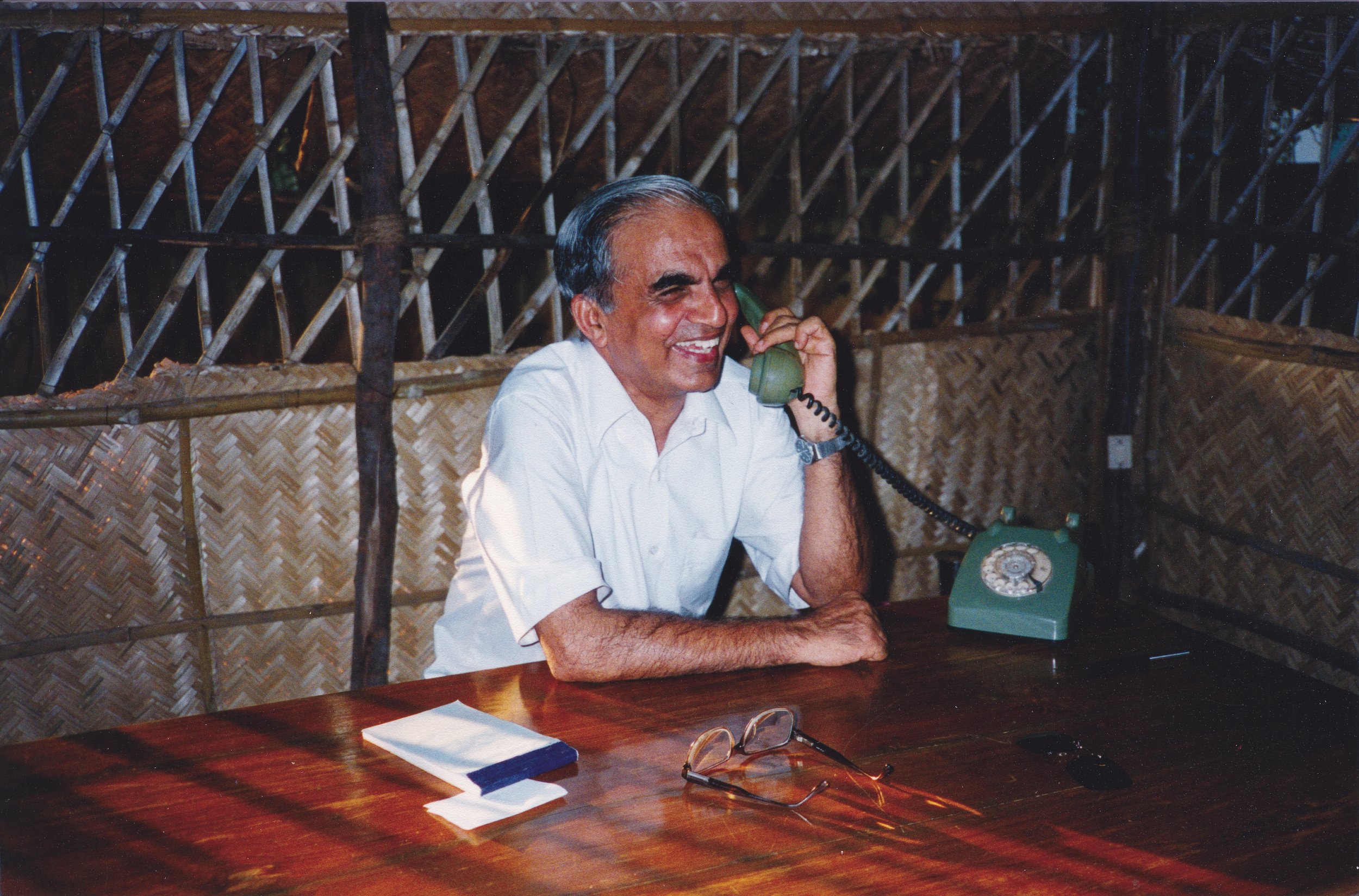
TKV Desikachar at the KYM in the early 1990s.
A Debt Beyond Repayment
There are some debts in life that can never truly be repaid.
Money can be returned, favours exchanged, and gifts offered. But what can one give to someone who gave meaning to one’s life?
This was a question that had long lived quietly in TKV Desikachar’s heart.
Few students have been as fortunate as he was. Born into the household of his teacher, Yogācārya T. Krishnamacharya, Desikachar did not have to travel across India in search of wisdom. The teachings were woven into the fabric of daily life. They unfolded at the dining table, during walks, through conversations, and through the simple privilege of observing a master at close quarters.
As he matured, his sense of good fortune deepened into gratitude.
Desikachar understood how rare his circumstances had been. He had witnessed Krishnamacharya not only as a father, but also as a teacher, healer, scholar, and devotee. Some lessons were taught directly. Others were absorbed through years of observation. The older he became, the more deeply he appreciated the extraordinary gift he had received.
Yet gratitude naturally seeks expression.
How could he thank the man who had given him so much?
Desikachar knew his father well enough to understand that material offerings would hold little value. Krishnamacharya had little interest in wealth, status, or possessions. But there was one thing he cherished above all else: the teachings.
Throughout his life, Krishnamacharya had dedicated himself to preserving and transmitting the wisdom of Yoga. His greatest satisfaction came from seeing those teachings benefit others.
Gradually, a simple but profound idea began to take shape.
If he could not repay his teacher directly, perhaps he could create a place where the teachings could continue to live and serve.
Perhaps his greatest gift would be a home for the work itself.
That thought would eventually lead to one of the most significant developments in the modern history of Yoga.
A Room on the Rooftop
On 14 April 1976, together with his friend and colleague Srivatsa Ramaswami, Desikachar founded the Krishnamacharya Yoga Mandiram, now known throughout the world simply as the KYM.
The vision was clear. He wanted to create a non-profit charitable institution that would preserve and share the teachings of Krishnamacharya while making them available to those who needed them in India.
The beginnings, however, were remarkably humble.
The initial investment amounted to roughly 50 US dollars today. There were no wealthy benefactors, elaborate facilities, or grand expansion plans. In fact, Desikachar could not even afford to rent a separate building.
The first KYM occupied a single room on the top floor of his family home in Chennai.
Looking back, it is easy to forget those ordinary beginnings. Meaningful things rarely start with fanfare; more often, they start quietly, guided by intention and service.
Students seeking guidance arrived, as did individuals struggling with physical, emotional, and psychological difficulties. The rooftop room evolved into an active center where people found support, learned practices, and saw improvements in their well-being. As more experienced positive change, the KYM developed a reputation as a place for community, healing, and transformation.
As the work expanded, the organisation eventually moved to a larger facility on St Mary’s Road. A decade later, it relocated again to its present home in Ramakrishna Nagar, Chennai.
The buildings changed.
The purpose did not.
From the beginning, the KYM was intended to be a place where a living tradition could continue to serve. What began as a room on a rooftop was slowly becoming something much larger than anyone could have imagined.
When Yoga Became Medicine Again
One of the great misconceptions of modern Yoga is the belief that its therapeutic applications are somehow new.
In reality, Yoga has been used for healing purposes for centuries.
Krishnamacharya understood this deeply. Throughout his life, he worked with individuals facing a wide variety of physical and psychological challenges. He viewed Yoga not only as a spiritual discipline, but also as a sophisticated system for reducing suffering and restoring balance.
Desikachar inherited this understanding directly from him.
At a time when much of the modern Yoga world was becoming increasingly identified with posture practice, he remained deeply interested in Yoga’s therapeutic potential. He recognised that Yoga offered tools capable of influencing not only the body, but also the breath, emotions, behaviour, and one’s relationship to life itself.
This understanding became one of the defining features of the KYM.
The principle was simple: every individual was different, and therefore every therapeutic approach had to be different.
Desikachar frequently emphasised that Yoga should adapt to the individual rather than forcing the individual to adapt to a method. Two people could arrive with the same diagnosis and yet require entirely different practices. The role of the therapist was not merely to understand the condition, but to understand the person.
To do this required access to the full range of Yoga’s tools. Āsana, breathing practices, meditation, chanting, visualisation, counselling, mudrā, dietary recommendations, and lifestyle adjustments could all become part of an individual’s programme. Each recommendation was adapted according to the student’s needs and circumstances.
This approach gradually began producing results that attracted attention.
Over time, physicians throughout Chennai started referring patients to the KYM. Many arrived carrying years of frustration and unsuccessful treatment experiences. Some sought support for epilepsy, diabetes, hypertension, anxiety, depression, chronic pain, or gynaecological disorders.
What doctors observed often surprised them.
Patients who sincerely engaged with their practices frequently reported meaningful improvements in their well-being. While Yoga was never presented as a replacement for medicine, it often proved to be a valuable complementary approach that addressed dimensions of health not easily reached through medication alone.
As word spread, the KYM gradually evolved into what was arguably the world’s first dedicated Yoga therapy clinic.
Today, Yoga therapy is an established field with professional organisations, training programmes, conferences, and research projects worldwide. In the 1970s and early 1980s, however, there was very little precedent for such work.
Visitors to the KYM during those years would have encountered a remarkable cross-section of humanity. Doctors, labourers, executives, homemakers, students, wealthy families, and those with very little often sat side by side in the waiting area. Illness seemed remarkably democratic. Yet so too was Desikachar’s willingness to help. Regardless of background or circumstance, those who came seeking guidance were received with the same care and attention.
Those who met him spoke of his unique ability to understand people and his skill in pulse reading to assess conditions. Yet most were impressed not by technique, but by his capacity to listen.
It was his ability to listen.
People often arrived seeking help for a disease and left feeling that someone had finally understood the human being behind the diagnosis.
Those who worked with Desikachar often noticed that consultations rarely ended when the clock said they should. If someone arrived distressed, confused, or frightened, he would often give them the time they needed, even when a long line of people was waiting outside. This sometimes meant returning home much later than expected, with family members patiently waiting for him. In many ways, his family also contributed to his work by quietly holding space for him to fulfil his dharma. But for Desikachar, healing was never simply about prescribing a practice. It was about helping a person feel seen, understood, and supported. Many students remember leaving his room with a practice in hand, but also with something less tangible: the feeling that someone genuinely cared about their well-being. In an increasingly busy world, that quality of attention was perhaps one of the most therapeutic gifts he offered.
This capacity to listen deeply was one of the reasons so many people trusted him. While his knowledge of Yoga was extraordinary, it was his humanity that often left the deepest impression.
The Steward, Not the Owner
As the KYM continued to grow, Desikachar’s relationship with the institution remained surprisingly simple.
Although he had founded it and remained one of its principal teachers, he never regarded it as personal property. He served there in an honorary capacity from the beginning and never took payment from the organisation for the classes he taught.
In an age increasingly fascinated by ownership, Desikachar remained committed to stewardship.
The KYM was never intended to become a commercial enterprise or an international franchise. It was established as a charitable trust serving the people of India, particularly those in Chennai and the surrounding region. Although students travelled from around the world to learn there, Desikachar remained clear that the institution itself should remain rooted in the community it was created to serve.
For him, preserving the integrity of the work was always more important than expanding its reach.
Yoga was never a commodity.
It was a service.
A Second Generation of Service
By the turn of the millennium, a second generation had begun contributing to KYM's work.
From the year 2000 onwards, Desikachar’s son, Dr Kausthub Desikachar, served the organisation in a variety of capacities. Much of this work was undertaken voluntarily while simultaneously building a career and supporting a young family.
He became involved in key initiatives that shaped the organisation's future.
One of the most significant was the establishment of the publications department, which later evolved into the media department. As interest in the teachings continued to grow, it became increasingly important to create systems for documenting, preserving, and sharing knowledge.
Another important contribution was the formalisation of the research department. This was undertaken together with Dr Latha Satish, a long-time student of TKV Desikachar and later Kausthub’s PhD mentor. Together, they sought to strengthen the research culture within the institution and to create frameworks for exploring and documenting the therapeutic applications of Yoga with greater rigour.
Among the projects that emerged during this period, KYM-Mitra stood out. Conceived as a social outreach initiative, it sought to bring the benefits of Yoga to socially and economically disadvantaged communities. The project reflected a simple conviction: that the healing potential of Yoga should not be limited to those with financial means.
In many ways, these efforts represented a continuation of the same spirit that had inspired the founding of KYM. Just as Desikachar had sought to honour his teacher through service, his son Kausthub sought to contribute to the institution that he had nurtured with such dedication and care.
Yet Desikachar’s vision extended beyond the walls of Chennai.
In 2006, he called upon Kausthub Desikachar to assume a new responsibility: helping carry the Viniyoga tradition into the wider world. Together, they embarked upon a journey that would eventually lead to teaching programmes, therapeutic initiatives, and training projects across multiple countries.
As those responsibilities expanded, it became increasingly clear that they required undivided attention. Over time, Kausthub withdrew from all positions within the KYM in order to focus fully on the international work that Desikachar had entrusted to him.
In many respects, this transition reflected a familiar pattern within traditional lineages. One generation establishes foundations. The next builds upon them. Eventually, new responsibilities call the work beyond its original boundaries.
The Legacy Continues
Every institution passes through different seasons.
Those who had the privilege of witnessing the KYM during the years when Desikachar was actively involved often speak of that period with great affection. Students came not only to learn Yoga, but to experience direct guidance from someone who had spent decades studying with Krishnamacharya himself.
Like all such periods, however, that chapter eventually came to an end.
A few years after Desikachar withdrew from the organisation, the KYM entered a new phase of its history. Every institution must eventually learn how to continue after the departure of the individuals who shaped its formative years.
It would be difficult for any organisation to recreate the extraordinary circumstances that existed during Desikachar’s years at the KYM. The individuals entrusted with carrying the work forward today have naturally had far less direct contact with him than those who worked alongside him over many decades.
Yet this reality should not prevent us from appreciating the sincere efforts of those who continue the work.
The KYM remains an organisation that serves the people of India, particularly the citizens of Chennai. It continues to provide valuable programmes, guidance, and support to many who seek its services. Whatever changes may have occurred over the years, the intention to serve through Yoga remains alive within its walls.
Traditions endure not only because of visionary founders, but also because of the many individuals who quietly and faithfully continue the work after the founders are gone.
As we remember the remarkable contribution that Desikachar made through the creation of the KYM, it is equally important to remember those who continue to care for that legacy today. Their efforts help ensure that the light kindled nearly fifty years ago has not been extinguished.
And for that, they deserve gratitude too.
An Offering That Continues
The KYM was Desikachar’s answer to a question that had lived in his heart for many years.
How does one thank the person who has given meaning to one’s life?
His answer was not found in words, gifts, or recognition.
It was found in service.
What began as a small room on a rooftop became a place where thousands found guidance, healing, and hope. It helped establish Yoga therapy as a respected discipline and ensured that Krishnamacharya's teachings would continue to reach future generations.
Yet it is unlikely that Desikachar would have measured its success by its size, reputation, or influence.
He would simply have been grateful that the teachings continued to serve.
In the end, that was always the purpose.
The KYM was never intended to be a monument.
It was built as an offering.
This article was first published in the Yoga Magazine UK in the July 2026 edition. To download the artcle as a pdf click here>