
Not Copies, But Custodians!
How TKV Desikachar prepared a living tradition for the future!
by Dr Kausthub Desikachar, PhD
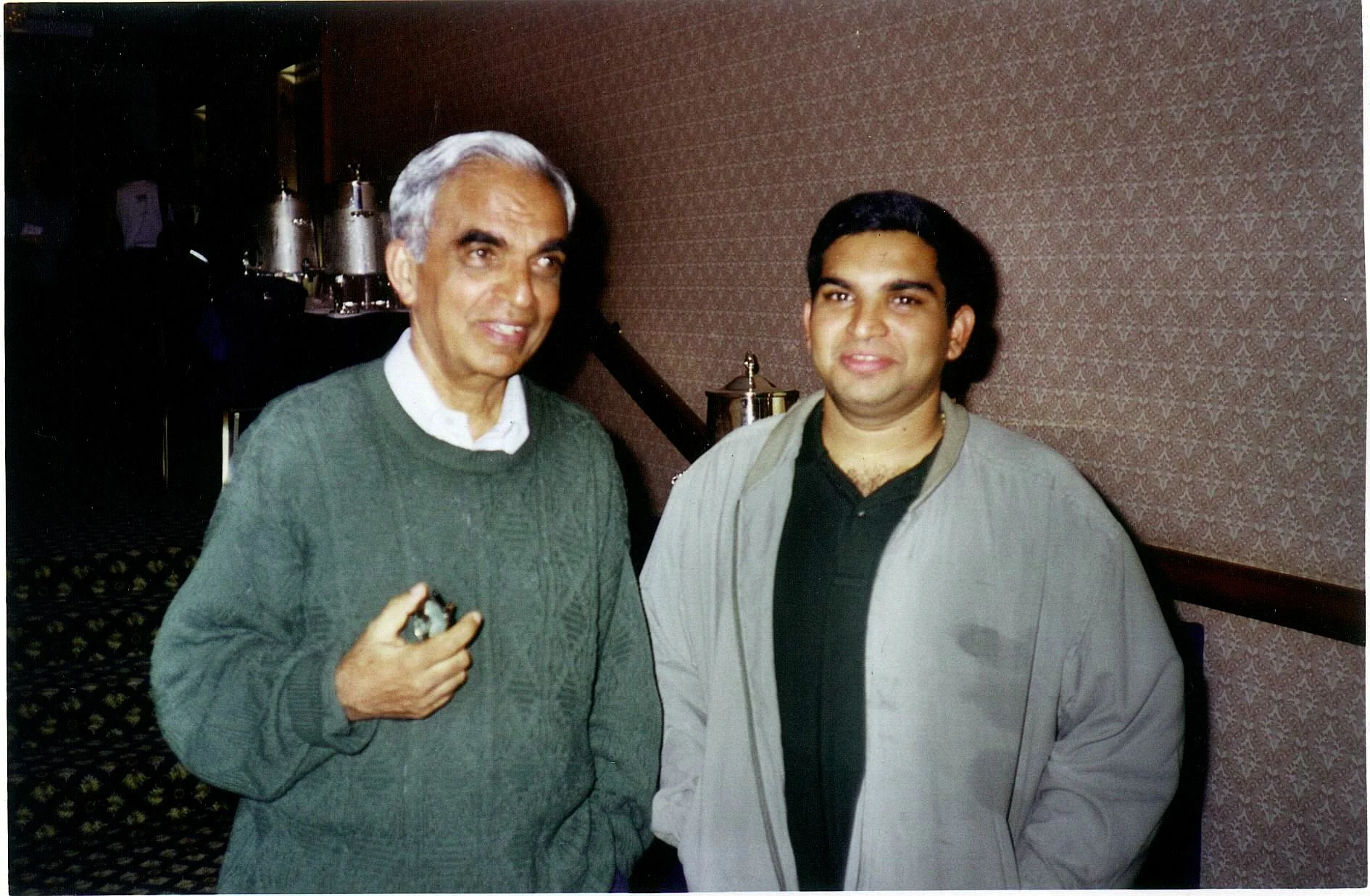
TKV Desikachar and Kausthub Desikachar at a Yoga Conference, Year 2000.
When Teaching Becomes Transmission
By the beginning of the twenty-first century, TKV Desikachar had little left to prove. His books had reached readers around the world, students travelled from every continent to study with him, and the Krishnamacharya Yoga Mandiram had become internationally respected for its pioneering work in Yoga Therapy. The teachings he had inherited from Yogācārya T. Krishnamacharya were no longer confined to Chennai. They had begun quietly shaping how Yoga was understood across the world.
Yet success was never something that occupied him for very long.
Those who knew him well recognised that he was always looking beyond the work already accomplished towards the responsibility that still lay ahead. As the years passed, one question increasingly occupied his thoughts: How does a living tradition continue when the teacher who embodies it is no longer there?
For Desikachar, this was never a question of preserving his own reputation. Rather, it reflected his understanding that wisdom rarely disappears overnight. More often, it gradually becomes simplified: principles become techniques, dialogue becomes formula, and before long, a living tradition risks becoming something carefully repeated but no longer deeply understood.
Having spent over three decades studying directly under his father, he knew that the tradition could never be preserved simply through books or institutions. The teachings of Krishnamacharya had never been a collection of fixed methods; they were a way of observing, adapting and responding to each individual with intelligence and compassion.
As I look back today, I realise that my father's teaching gradually began to change. He was still travelling, teaching and treating patients, yet another process was quietly unfolding beneath the surface. Increasingly, he seemed less concerned with simply educating students and more interested in preparing future custodians of the tradition.
Students inherit knowledge.
Custodians inherit responsibility.
The Whole Orchestra
The worldwide growth of Yoga delighted my father. Millions of people who might never otherwise have encountered Yoga were discovering practices that improved their health and well-being. Yet alongside this enthusiasm, he also noticed that Yoga seemed to travel as an increasingly efficient traveller, carrying less with every stop. By the time it reached many places, āsana had checked in successfully, while mantra, philosophy, meditation, chanting, ritual and even the understanding of breath appeared to have been left waiting at the departure gate.
He never criticised this development. Instead, he continued teaching exactly as he had been taught.
He often reminded students that āsana was only one instrument within a much larger orchestra. Beautiful music could certainly be produced by a single violin, but no one should mistake the violin for the entire symphony. The richness of Yoga emerged only when its many tools worked together, each supporting the others according to the individual's needs.
This understanding shaped every teacher training programme he conducted.
Students were expected not simply to remember practices, but to understand relationships. Why would two people with the same medical diagnosis receive entirely different programmes? How could a mantra transform the effect of a breathing practice? What influence did age, family life, occupation, diet, faith, or emotional state have upon the choice of practice?
There were rarely simple answers.
Nor did my father want there to be.
He believed that the purpose of education was not to produce teachers with ready-made solutions, but teachers who had learned how to observe, think carefully and remain humble enough to recognise that every individual still had something to teach them.
Looking back, I realise that this was perhaps the greatest lesson he passed on. The tradition was never about applying techniques. It was about learning how to see.
Preparing Custodians, Not Copies
One of the greatest misconceptions surrounding lineage is the belief that its purpose is to produce faithful copies of the teacher. My father knew this was never how authentic traditions survived.
His own father had taught many remarkable students, yet none of them resembled one another. Some became scholars; others, physicians, teachers, therapists, or spiritual practitioners. What united them was not similarity of personality but fidelity to the principles they had inherited.
Desikachar adopted exactly the same approach.
Many of his senior students eventually became respected teachers throughout the world, each contributing according to their own strengths. Uniformity, he believed, could easily be manufactured. Authenticity could not.
The same philosophy shaped the way he trained me.
Although I had the privilege of being both his son and his student, he never suggested that family alone entitled anyone to represent the tradition. If anything, it demanded greater humility and discipline. Knowledge was never inherited simply through birth; it had to be earned through years of study, practice and service.
As my own work gradually expanded through teaching, Yoga Therapy, research and service within the Krishnamacharya Yoga Mandiram, he increasingly encouraged me to travel internationally. At first, I regarded these journeys simply as opportunities to teach abroad. Only much later did I realise that he was quietly preparing me for responsibilities that extended far beyond the work we were doing in Chennai at the time.
He often remarked that every generation inherits a different dharma. His father's responsibility had been to preserve the tradition. His own had been to demonstrate its relevance to modern life. The next chapter, as he increasingly saw it, would ensure that these teachings could travel across cultures without losing either their depth or their integrity.
At the time, I had little idea how profoundly those words would shape my future.
A Quiet Commission
Among the many memories I treasure of my father, there is one that has acquired greater significance with every passing year.
In April 2001, he handed me a handwritten note.
It was neither presented as an important document nor accompanied by any lengthy discussion. At the time, it appeared to be little more than a page of personal reflections. Only years later did I realise that it contained one of the clearest expressions of his vision for the future.
The opening lines read:
"I want to translate what T.K. has taught me… Yoga Valli, Citacittatva Mīmāṃsā, Bhagavad Gītā, Karma Kāṇḍa. Quite a vast project. Once translated, it will be for you to use."
Those few sentences reveal much about how my father understood his own role within the lineage.
He never regarded himself as the owner of the teachings he had received from Krishnamacharya. His responsibility was to study them, understand them, and translate them faithfully for a changing world. Once that work had been completed, they could not remain with him; they had to be entrusted to the next generation.
Looking back, I realise how carefully he chose his words.
He did not write that the teachings would belong to me.
He wrote that they would be for me to use.
That distinction says everything about how he understood lineage. Knowledge is never owned. It is entrusted.
As I continued reading, the note became even more remarkable.
Referring to my future, he wrote:
"You cannot do both roles: KYM and what the West is waiting for you."
At the time, I found those words difficult to understand. My life revolved around the KYM, and I naturally assumed that it would remain the centre of my work. My father, however, had already begun to see something I could not.
He recognised that the growing international interest in authentic Yoga required the tradition itself to travel—not as a collection of techniques, but as the complete teaching he had inherited from Krishnamacharya.
The next lines surprised me even more.
"Your calibre and KYM are almost like Diamond and clay."
Read in isolation, the sentence may sound unusually direct. Yet my father was never given to empty praise. He was trying to persuade me that my responsibility lay beyond the institution in which I was then serving. His concern was never about position or recognition; it was about ensuring that the work he believed needed to be done would not remain undone.
Finally, he concluded with words that proved remarkably prophetic:
"KYM cannot grow to international standards. KYM is fine for Chennai."
At the time, I could not have imagined how accurately those few handwritten paragraphs would anticipate the years that followed.
Today, I see them for what they truly were.
A quiet commission from a father to his son.
Building Beyond Borders
The vision my father outlined in that handwritten note gradually took shape over the years that followed. As increasing numbers of students from Europe, North America, Asia and Australia sought authentic training in the tradition of Krishnamacharya, it became clear that the international transmission of these teachings required a framework different from the role the Krishnamacharya Yoga Mandiram had originally been created to fulfil. That recognition marked the beginning of a new path for the tradition and for me.
It was with this understanding that, in 2006, we established the Krishnamacharya Healing & Yoga Foundation (KHYF). From the outset, my father was careful to distinguish its purpose from that of the KYM. Although both organisations shared the same philosophical foundation, they were never intended to perform the same function. The KYM remained the charitable institution through which he wished to serve the people of Chennai, particularly through Yoga Therapy and community work. The KHYF, on the other hand, was conceived as the official umbrella organisation responsible for preserving, teaching and representing the complete tradition internationally.
This distinction reflected something my father understood very clearly: every institution, like every individual, has its own dharma. The KYM had fulfilled its purpose with extraordinary distinction. It had become one of the world's most respected centres for Yoga Therapy and had introduced thousands of people to a deeply personalised understanding of Yoga. There was no need for it to become an international organisation simply because interest in Yoga was growing elsewhere. That responsibility belonged to another chapter of the tradition.
What impressed me most during those years was the remarkable absence of personal ambition in the way my father approached these developments. He was never interested in building an international empire or expanding an organisation for its own sake. His concern was always far simpler and far deeper: How do we preserve the integrity of the teachings while allowing them to reach those who genuinely seek them?
He often reminded me that institutions are only ever instruments. They provide continuity, create opportunities for learning, and bring communities together. Yet no institution, however successful, can preserve a living tradition by itself. Traditions ultimately survive because teachers dedicate themselves to understanding them deeply enough to embody them faithfully before passing them on to the next generation.
It was a lesson that has remained with me ever since.
When the Teacher Is No Longer There
One of the greatest tests of any tradition begins not during the lifetime of its teacher, but after the teacher has gone.
While a master is present, there is always someone to clarify misunderstandings, refine interpretations, and gently correct the countless small deviations that naturally arise over time. Once that guiding presence is no longer there, the responsibility shifts entirely to those entrusted with carrying the work forward.
My own journey took an unexpected turn in 2012 when, after many years of serving as a teacher, therapist, researcher and Trustee, I stepped away from the Krishnamacharya Yoga Mandiram. At the time, I could not fully appreciate how closely this transition echoed the vision my father had shared with me more than a decade earlier. Only with hindsight did I begin to recognise that what had once appeared to be a difficult ending had, in fact, created the space for another responsibility to unfold.
Four years later, in 2016, my father passed away.
For our family, for his students, and for the international Viniyoga community, it marked the end of an extraordinary chapter. Yet even amid the sadness, I found myself repeatedly returning to the handwritten note he had given me in 2001. The words no longer read as predictions. They read as guidance.
Later that same year, together with two of my senior students in Belgium, we established KHYF International as a non-profit organisation dedicated to continuing the international work that my father had envisaged. The intention was never to create a new lineage or an alternative school of Yoga, but to provide a home through which the complete Viniyoga tradition could continue to be studied, practised and transmitted with the same spirit in which it had been entrusted to us.
As the international community continued to grow, the organisation itself also evolved. In 2022, KHYF International became Viniyoga International, a name that more clearly reflected the worldwide community it had come to represent while remaining firmly rooted in the lineage of Yogācārya T. Krishnamacharya and TKV Desikachar.
During these same years, the Krishnamacharya Yoga Mandiram also entered a new chapter under different leadership. It continues to introduce many sincere students to Yoga and Yoga Therapy, and its contribution to the field deserves respect. Yet, as happens in every institution that survives its founder, its priorities and emphasis have naturally evolved with time.
Those of us who had the rare privilege of studying directly under Desikachar recognise how difficult it is to preserve not merely the external forms of his teaching, but also the extraordinary subtlety that characterised his teaching. His genius never lay simply in the practices themselves. It lay in the discernment with which he selected them, the effortless way he integrated the many tools of Yoga, and the profound humanity with which he approached every individual who came before him.
Such qualities cannot simply be documented in manuals or standardised through curricula. They emerge through apprenticeship, observation, reflection, and years of lived experience. This is not a criticism of any institution or teacher. It is simply one of the enduring realities of every authentic lineage. The further one moves from the source, the greater the responsibility to preserve not merely the words that were spoken, but the wisdom that gave those words their life.
Lighting Another Lamp
As I reflect on my father's life today, I find myself returning less often to his public achievements and more often to the quiet decisions that shaped the tradition's future.
History will rightly remember him as a pioneering Yoga therapist, an exceptional teacher, an accomplished author, and one of the foremost interpreters of Krishnamacharya's teachings. Yet, with the passage of time, I have come to believe that his greatest contribution was something altogether quieter.
He understood that the purpose of lineage is not to produce faithful copies of a teacher, but faithful custodians of a living tradition.
More than two decades have passed since my father quietly placed that handwritten note in my hands. Time has given those few paragraphs a significance that neither of us could have fully appreciated then. Organisations have evolved, new generations of teachers have emerged, and the tradition continues to reach places that my grandfather could scarcely have imagined. Yet whenever I unfold that single sheet of paper, I am reminded that it was never really a letter about institutions or international work.
It was a father helping his son recognise his dharma.
Today I understand why he chose to write those thoughts rather than simply speak them. Spoken advice can easily be forgotten. A handwritten letter waits patiently until experience catches up with understanding. Mine certainly did.
There is an old saying that one lamp loses nothing by lighting another. Looking back, I realise that this simple image captures not only my father's life, but the very essence of paramparā. The light that Yogācārya T. Krishnamacharya kindled in my father's heart was never meant to remain there. Nor was the light my father entrusted to me intended to become my own. It was always meant to illuminate others.
Perhaps that is the truest measure of any teacher—not how brightly he shines during his own lifetime, but how many other lamps continue to burn because of his light.
This article was first published in the Yoga Magazine UK in the August 2026 edition. To download the article as a pdf click here>