
To Last… in Translation!
How TKV Desikachar translated Krishnamacharya’s genius for generations.
by Dr Kausthub Desikachar, PhD
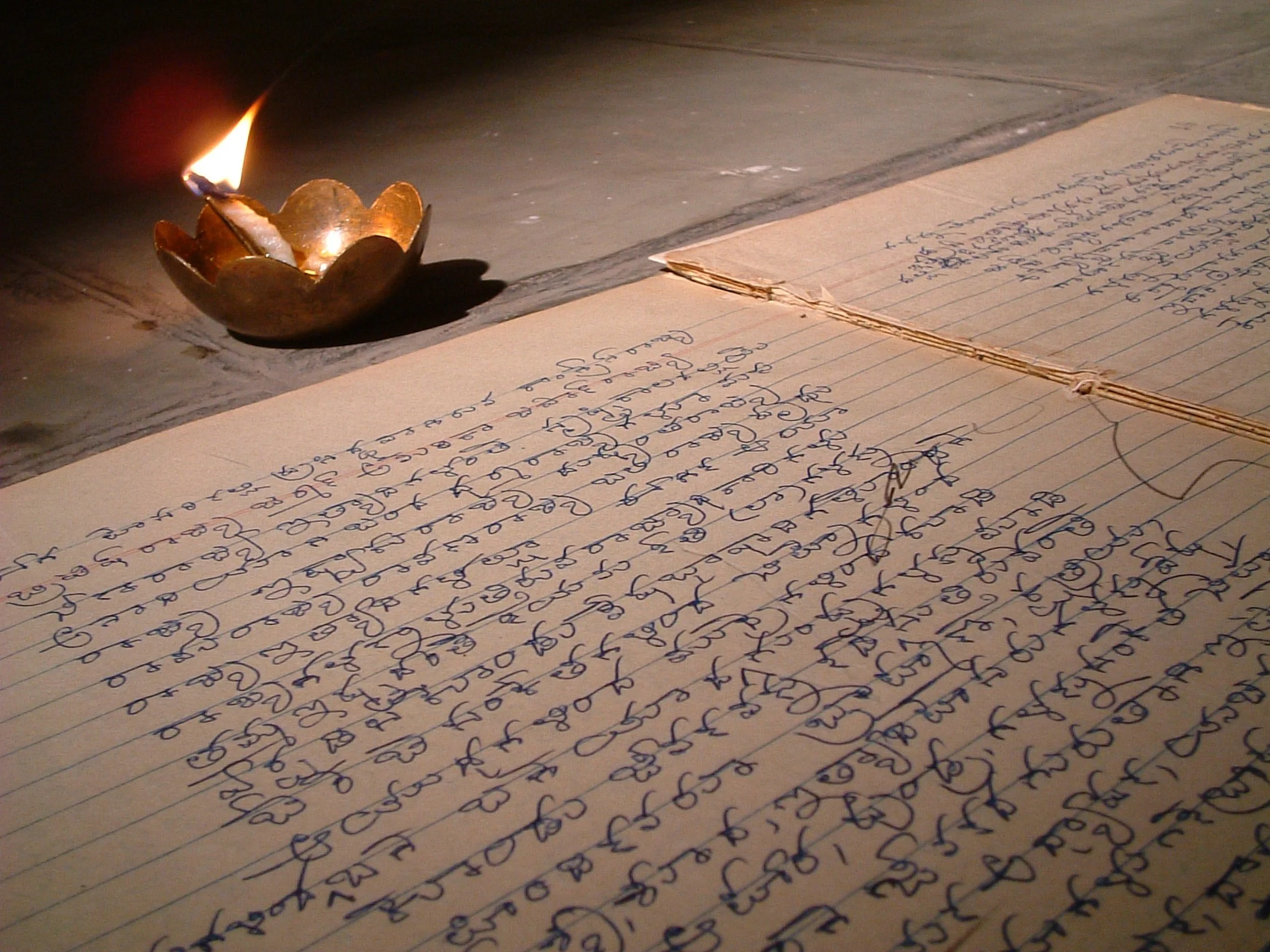
One of the many handwritten manuscripts of Yogācārya T Krishnamacharya in Telegu script.
A Familiar Language in Different Clothes
My grandfather, T. Krishnamacharya, was not always easy to understand. His writing style sometimes felt like an entrance test for anyone who wanted to learn from him.
He wrote in Sanskrit but used the Telugu script, which was part of his family's tradition. It's important to remember that a language and its script are different. Sanskrit can be written in several scripts. Many people today think of Devanāgarī, but Sanskrit is not limited to that script.
So, while my grandfather’s approach made sense from a language point of view, it could be inconvenient for readers.
Someone who could read Telugu script might say the words correctly but not know what they meant in Sanskrit. A Sanskrit expert who couldn’t read Telugu script might understand the ideas but not be able to read the text. One person could open the envelope but not understand the letter, while another could understand the letter but not open the envelope.
Even someone who could do both would still find that my grandfather left more for them to discover.
Reading his words was one thing, but truly understanding what he meant was another.
A Commitment in Every Word
According to the account passed down in our family, my grandfather’s promise to his teacher grew out of a story of refuge and gratitude. His ancestors sought refuge in Tirumala, the holy hills home to the sacred temple of Lord Venkaṭeśvara, one of India’s most revered places of worship. Situated in the Andhra region, where Telugu is the native language, Tirumala became an enduring part of the family’s spiritual heritage.
To honour this connection, Krishnamacharya’s teacher asked him to retain Telugu as the lingua pura of his written work. In practice, this meant preserving Telugu script even when the language of composition was Sanskrit. The language carried the teaching; the script honoured the land that had sheltered his ancestors.
For my grandfather, such a request was no small matter. A promise to his teacher was something to be lived, patiently and faithfully. Every page he wrote thus became a quiet act of remembrance, linking his scholarship with his ancestors, their place of refuge, and the teacher whose wishes he held sacred.
In the teaching culture he inherited, he approached sacred knowledge with considerable care. Its value lay in what it could awaken within a person, and that required preparation. A teaching offered without the necessary foundation could be misunderstood, reduced to something superficial, or applied inappropriately.
This practice may have had another side, though we should see it as a possibility, not a certainty. Maybe his choice of script was also a way to encourage readers to approach his writings with patience and care. We can’t say for sure this was his intention. Still, his manuscripts clearly required something that is less common today: time.
Knowledge Does Not Ripen on Command
Today, we often think that having access to something means we understand it. If we can download a text, we might feel we have learned its lesson. If we highlight a good sentence, we may think we are already on the path to understanding. Or if we have heard some words of wisdom at a weekend workshop, we are already qualified to teach it the next day.
Unfortunately, the mind does not become clear simply because the screen is bright.
Traditional teaching recognised a distinction between encountering knowledge and becoming ready to receive it. Certain teachings required a foundation in practice, a degree of steadiness, and a relationship with someone who could guide their interpretation. Their significance unfolded as the student developed.
Symbolism played an important role in this process. A passage might offer something meaningful to a beginner while revealing further dimensions to someone with years of experience. The same words could accompany a student through different stages of life without exhausting their usefulness. This is why T Krishnamacharya taught his son, Desikachar, the Yogasūtra nine times.
This wasn’t about keeping knowledge for only a few people. At its best, it showed care for the connection between the teaching, the student, and what happens when the teaching is used.
A seed is valuable, but it won’t grow if you put it on a marble floor. The ground you choose is important.
My grandfather’s writings invite this kind of preparation. They ask the reader to bring more than curiosity, however enthusiastic that curiosity may be.
When Rivers Flow Within
One example concerns a passage in which my grandfather described three rivers meeting at a single point.
A beginner reader could understand this as a reference to a geographical confluence in India and find a perfectly reasonable meaning there. Yet, in the interpretation transmitted through his teaching, the rivers also pointed towards Iḍā, Piṅgalā and Suṣumṇā, the three principal nāḍī-s described in Yoga’s subtle understanding of the human system.
Suddenly, the landscape had changed. The more serious seeker was being invited to contemplate something within.
The geographical image had not become meaningless. It had acquired another dimension. An outer meeting of rivers could illuminate an inner relationship that a practitioner might explore through appropriate teaching and practice.
This is where translation gets especially challenging.
A translator might identify every word accurately and still miss the passage's significance. Conversely, an enthusiastic interpreter might discover elaborate symbolism that the author never intended. Both possibilities require care. A dictionary cannot settle every question, and imagination should not appoint itself the teacher.
The challenge is to recognise when a passage carries further meaning, what supports that interpretation, and how much can be explained responsibly.
In my grandfather’s case, familiarity with the way he taught was an invaluable guide. His written words belonged to a much larger world of spoken explanation, practice and relationship.
A Dictionary Needs Company
Working with these manuscripts in a meaningful way took a rare mix of skills.
The obvious linguistic task was reading Telugu script and understanding Sanskrit. But that was only the beginning. The translator also needed familiarity with Yoga’s concepts and practical disciplines, together with an appreciation of the wider spiritual and cultural context within which Krishnamacharya taught.
Above all, there was the question of knowing the teacher.
How did he use a particular expression? When was he speaking literally, and when was he pointing towards something subtler? How did he connect an apparently simple statement with a practice, a philosophical principle, or the needs of a particular student?
These are hard questions to answer just by reading a page.
Anyone who has spent years with a teacher knows that understanding gradually becomes informed by far more than formal definitions. One begins to recognise patterns of emphasis, connections between subjects, and distinctions that might escape a reader encountering an isolated sentence.
Even then, knowing a teacher well should make us more humble. It doesn’t mean we can make him say whatever we want.
My father, TKV Desikachar, brought an exceptional combination of linguistic understanding, practical experience and sustained personal study to this work. He had learnt from Krishnamacharya over decades. He knew the teachings through the demanding, living process of being his student.
That relationship gave him resources that no dictionary, however substantial, could provide. No other student of my grandfather had the same combination of sustained access, personal closeness and depth of engagement with his mind. My father’s privilege was to encounter the teachings across decades, to ask questions, revisit his understanding, and observe how Krishnamacharya brought the same principles to life in different circumstances. He came to understand how his teacher thought, alongside what he taught.
To me, this is what makes TKV Desikachar not only unique, but the only true successor and pure representative of his teacher’s teaching in its fullness. This conviction rests on far more than their relationship as father and son. It rests on the depth of his discipleship and the fidelity with which he carried that understanding forward. He could recognise the intention behind an instruction, the principle beneath an adaptation, and the thread connecting teachings that might otherwise appear unrelated. Such understanding gave him an exceptional ability to preserve my grandfather’s voice while helping a new generation hear it.
The Son Returned to the Page
Many people knew my father through his teaching, his therapeutic work, his conversations, or his ability to make a difficult idea feel approachable. Fewer would have known the patient work he undertook with my grandfather’s manuscripts.
Over many years, he devoted long hours in his study to reading, transcribing and interpreting them. It was quiet work, with little of the visibility that accompanies a lecture or an international seminar.
Yet its significance was considerable.
A manuscript might last as an object but become harder to access. The paper can be kept safe, the handwriting photographed, and the pages stored. But if fewer people can truly read and understand it, something important is still in danger.
My father’s task involved helping to preserve access to the teaching carried by those pages.
This aspect of his relationship with his father moves me deeply. After years of listening, questioning and practising, he continued to meet his teacher through the written word. A manuscript became another place in which the relationship could continue.
The work required concentration and restraint. There was no benefit in producing a smooth sentence quickly if the process distorted its meaning. Sometimes the responsible thing was to remain with a difficulty until a clearer understanding emerged.
Patience is rarely praised. Luckily, my father didn’t need an audience for the things that mattered most.
Changing the Script, Keeping the Depth
This work requires an important distinction. Since my grandfather had composed in Sanskrit, rendering those writings in another script did not mean translating them into Sanskrit. The language was already there.
Part of the task was transcription: making the Sanskrit accessible to readers who could not read Telugu script. Alongside this came the more demanding work of interpretation and clarification.
These processes are related, but they are not interchangeable.
You can change the script perfectly and still leave all the hard parts of meaning. You can also give an explanation that sounds clear but loses the depth of the original. My father had to balance making things accessible with staying true to the source.
He wanted serious students to be able to approach these teachings. At the same time, making a manuscript readable did not remove the need for study, practice or guidance.
This is a careful balance. An explanation should help the reader get started, but also leave room for more discovery. It should give enough guidance to move forward, without pretending that everything has been explained.
My father’s teaching showed this balance. He could make an idea feel important right away, without acting like that was all there was to it. A simple explanation could start years of further exploration.
That same sensitivity mattered when he returned to his father’s written work.
Fidelity Without Ventriloquism
Preserving the work of a great teacher presents a temptation that deserves honest attention. We may become so eager to demonstrate the teacher’s brilliance that we begin adding our own brilliance on his behalf.
Before long, we credit the original author with everything we happen to believe.
Interpreting responsibly takes discipline. We need to tell apart what the text says, what the teacher explained, what tradition adds, and what is just our own guess. These careful distinctions may not be dramatic, but they make the work more reliable.
For my father, closeness to Krishnamacharya carried a responsibility. The years he spent learning from him formed the basis for careful judgement, not a licence for unrestricted interpretation.
This matters even more when teachings have many layers. Depth should lead to careful explanation, not become an excuse for being vague.
A kind of love is also involved in allowing a teacher’s work to retain its difficulty. We do not honour someone by making every sentence conveniently agree with present expectations.
Sometimes we must let the text challenge us. Sometimes we must admit that we have not yet understood.
A little intellectual discomfort is a modest price to pay for honesty.
The Work Continues
Today, I continue this work with an awareness of what I have received from both my grandfather and my father.
The responsibility includes attending to the manuscripts, studying their meanings, and considering how to share their wisdom with students who live in very different circumstances from those in which the texts were written.
It also means remembering the limits of what I know. Being part of a family doesn’t make every sentence clear. Having a well-known last name is not a way to translate.
What helps is the teaching I have received, the practice through which I continue to explore it, and the willingness to return to a passage without insisting that it yield everything at once.
My father’s example remains central to this process. He showed how devotion could express itself through meticulous work, and how continuity could depend on quiet acts that few people ever witnessed.
The published page is just what people see. Behind it are hours of careful work, patient questions, and choices about language that seem small until you realize what they protect.
Helping the Words Find Their Voice
We often talk about what is lost in translation. My father’s work asks us to think about what can last. My grandfather’s deep learning was written down, but words shaped by years of study, practice, faith, and teaching needed more than safe keeping. They needed someone to help future generations understand them, so the teaching would stay alive.
My father understood that the manuscripts needed readers who could engage with them meaningfully. His work helped create that possibility, while respecting the depth that made the task necessary in the first place.
To me, this is still one of his most important but quiet contributions. He gave his time and understanding so future students could meet something of his teacher through those pages.
My grandfather left us words that ask us to look carefully. My father helped us find our way towards them.
Now, the invitation is ours: to read patiently, to practice sincerely, and to listen for what these words might still reveal.
This article was first published in the Yoga Magazine UK in the November 2026 edition. To download the article as a pdf click here>