
Yoga for Every Ability!
How TKV Desikachar Adapted Yoga to Serve Disabled Children.
by Dr Kausthub Desikachar, PhD
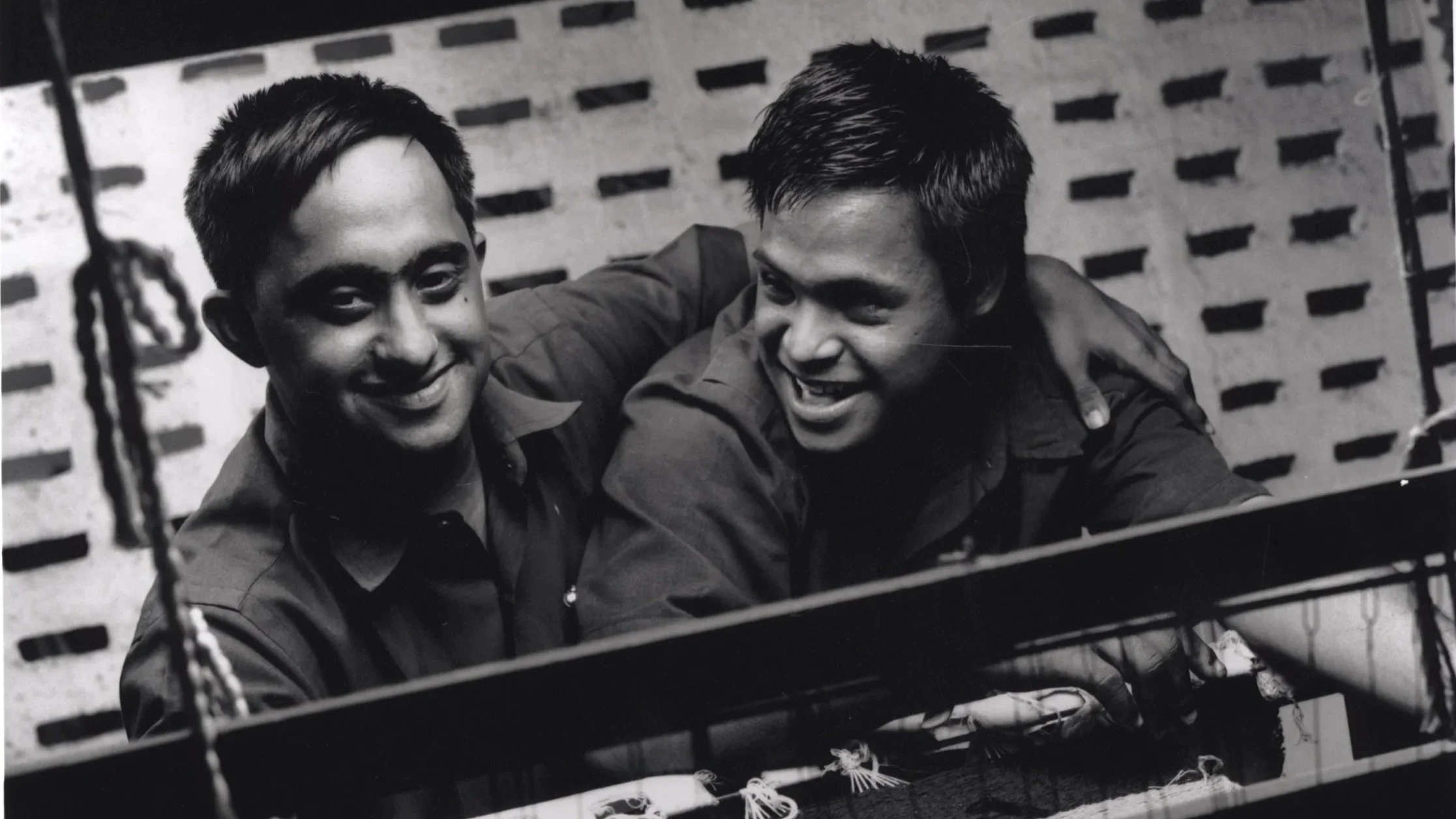
Some of the children with Down’s syndrome who benefited from TKV Desikachar’s teachings!
A Search for Something That Could Truly Help
Many years ago in Chennai, Professor P. Jeyachandran, a psychologist working closely with children with special needs, began searching for ways to improve the quality of their daily lives. He was not looking for miracles, nor was he seeking someone who would promise that disability could somehow be erased. His concern was far more practical and humane: could something help these children live with greater ease, confidence, independence and dignity?
A German colleague suggested that he explore Yoga.
Jeyachandran was open to the idea but remained cautious. He knew the children he worked with very well, including their strengths, limitations, and the complexity of their conditions. He started visiting Yoga teachers around Chennai, hoping to find someone to collaborate with.
The first teacher confidently told him, “Don’t worry, we can cure these children through Yoga.”
It was precisely the answer Jeyachandran did not want to hear.
These children did not need to be regarded as problems waiting to be cured. Nor was he interested in extravagant promises. He wanted to know whether Yoga could support them in practical ways. Could it help them concentrate better? Could it improve coordination or speech? Could it support learning? Could it help them function more independently?
He visited several more Yoga teachers and centres. Again and again, the answer was more or less the same: Yoga could cure them.
The certainty of these promises only made him more sceptical. As someone trained in psychology and used to working directly with children facing significant developmental challenges, he saw that these claims showed a lack of understanding about the children themselves. Eventually, Jeyachandran started to question whether Yoga had anything real to offer.
Before giving up, however, another friend persuaded him to meet one final teacher.
That teacher was TKV Desikachar.
“Sir, Let Us Try”
Jeyachandran explained his work, his concerns, and what he hoped to explore. Desikachar listened carefully. Then, instead of promising a cure or claiming expertise he did not possess, he replied:
“Sir, let us try. I am not an expert in Special Needs like you are. I am proficient in Yoga. Let us both work together and see if it helps.”
It was a simple response, but it contained something that had been missing from all the previous conversations: humility.
For Jeyachandran, this made all the difference.
Desikachar did not downplay the psychologist’s expertise to make Yoga seem more important. He openly admitted that Jeyachandran knew these children much better than he did, while also recognising his own deep knowledge of Yoga could be helpful. Instead of letting one field take over, he suggested working together.
Let us try.
Those three words reveal a great deal about Desikachar’s approach to Yoga.
He was confident in the tradition without exaggerating what it could do. He did not have to prove that Yoga could cure every illness, solve every problem, or replace other fields of knowledge. He learned a great deal about Yoga and Yoga therapy from his father, T. Krishnamacharya, but this did not make him arrogant.
If anything, the depth of his knowledge made him more aware of what he did not know.
This was not uncertainty. It was discernment.
Two Experts, One Purpose
For approximately the next decade, Desikachar and Professor Jeyachandran worked together, with guidance from Krishnamacharya, to explore how Yoga might be adapted for children with special needs.
What emerged was not a fixed system imposed upon them, but an evolving process of observation, experimentation, learning and refinement.
The central question was never, “How do we make these children practise Yoga properly?”
It was, “How can Yoga be adapted so that it serves these children?”
That distinction lies at the heart of Desikachar’s teaching.
He often said that Yoga should be adapted to each person, not the other way around. Age, physical ability, mental state, cultural background, responsibilities, and life stage all mattered. That meant there could never be one practice that worked for everyone.
When working with children with special needs, this principle acquired an entirely new dimension.
Jeyachandran understood the children, their developmental profiles and behavioural patterns. Desikachar understood how the many tools of Yoga could be modified and combined. Krishnamacharya offered guidance from the depth of the tradition.
Each brought something different, and that was precisely why the collaboration was fruitful.
When Yoga Adapts to the Child
The practices had to respond not only to different physical abilities but also to varying levels of comprehension, attention, communication and emotional regulation.
Some children could follow verbal instructions more easily than others. Some required visual demonstration and repetition. Some had difficulty coordinating movement and breath. Others struggled to remain attentive for long periods.
The conventional expectations of a Yoga class were therefore of little relevance.
The task was not to make these children resemble other Yoga students. It was to discover which elements of Yoga could meaningfully support their lives.
Movements sometimes needed to be simpler. Sequences were shortened. Breathing exercises were chosen carefully. Sound and chanting could play a big role. Repeating activities helped build comfort and confidence. The length of practice was set to fit each child, not a fixed schedule.
Even the usual measures of success had to be reconsidered.
For Desikachar, the question was not whether a child could perform an impressive posture. It was whether the practice helped that child function better in life.
Could attention be sustained a little longer? Could speech become clearer? Could coordination improve? Could confidence grow? Could learning become easier?
These questions mattered far more than external performance.
This was Viniyoga at its most practical. The value of a practice was not about how Yoga looked from the outside, but about how it changed the life of the person doing it.
Small Changes, Remarkable Consequences
Gradually, Jeyachandran and Desikachar began to observe changes.
In some children, physiological symptoms became more manageable. Drooling reduced or stopped. Some experienced fewer seizures. Speech became clearer for certain students. Attention improved. Children who had previously struggled to participate in structured learning began showing a greater capacity to engage.
But some of the most significant changes were not merely physical.
Confidence grew.
Children who had often been defined by what they could not do began discovering things they could do. Some became more independent in daily activities. Others demonstrated levels of educational progress that had not previously been expected of them. Some progressed through their education in remarkable ways, and a few eventually completed university degrees.
For Jeyachandran, who had spent years working closely with these children, such developments were deeply significant.
Yet what made the work remarkable was not that Yoga had somehow “cured” disability, as those earlier teachers had promised. The underlying conditions did not simply disappear.
What changed was the quality of life around them.
And that distinction is essential.
Healing Is Not Always Curing
Healing and curing are not always the same thing.
Modern thinking often approaches health through the language of elimination. Something is wrong, and therefore it must be removed. If the problem disappears, treatment has succeeded; if the condition remains, treatment is sometimes regarded as having failed.
Human life is rarely so simple.
Many realities cannot simply be removed. Disability, chronic illness, ageing, bereavement and other human experiences may remain part of a person’s life. The meaningful question then becomes not only whether a condition can be eradicated, but whether the person can live more fully, confidently and peacefully within the circumstances they have been given.
Desikachar understood this deeply.
In his approach, yoga therapy was never merely about attacking symptoms. It was concerned with the whole human being. Sometimes an illness could be alleviated. Sometimes physical function could improve substantially. But there were also situations in which the role of Yoga was to help the person develop greater stability, clarity, confidence, autonomy or acceptance.
With the children Jeyachandran worked with, Yoga became precisely this kind of companion.
It supported possibilities rather than promising impossibilities.
A Tradition Strong Enough to Learn
Desikachar’s willingness to learn from experience was itself part of the tradition he had inherited from Krishnamacharya.
Krishnamacharya was deeply rooted in traditional texts, philosophy, and classical Yoga, yet formulas never imprisoned him. His teaching constantly responded to the person standing before him. The principles remained rooted; the application remained flexible.
Desikachar carried this spirit forward into new contexts.
Working with children with special needs showed clearly how an old tradition could stay alive without becoming rigid. In this way, tradition was not just repeating old methods because they were old. At the same time, innovation did not mean leaving tradition behind just because something was new.
The art lay in preserving essential principles while discovering how those principles could serve changing human circumstances.
This is also why Desikachar was happy to work with doctors, psychologists, teachers, and social workers. He did not see outside knowledge as a threat to Yoga. If someone had expertise that could help him better understand a student, he was ready to listen.
His relationship with Jeyachandran remains a beautiful example of this.
From Experiment to Wider Movement
As the results became increasingly visible, the work began attracting wider attention.
Desikachar and Jeyachandran organised conferences and workshops to share what they were learning. Parents were invited, along with psychologists, social workers, volunteers and professionals working with children with special needs. Rather than guarding the knowledge as proprietary expertise, they wanted others to understand how these approaches might be applied responsibly.
The programme continued to grow.
Eventually, the work received recognition and support from the Indian government, and similar initiatives were encouraged to learn from the developed model.
What had begun with one psychologist approaching one Yoga teacher had expanded into something much larger.
And yet its origins remained remarkably modest.
“Let us try.”
There had been no grand declaration announcing that Yoga had discovered the disability answer. There was a willingness to bring together different forms of expertise in the service of those who might benefit from them.
Seeds of Service Across Generations
This social dimension of Desikachar’s work did not end with his own direct involvement.
Years later, his son Kausthub sought to carry the same spirit of service into a broader social context through the Krishnamacharya Yoga Mandiram. Among the initiatives he helped create was the KYM-Mitra programme, which took Yoga beyond the walls of conventional institutions and into underprivileged communities.
The principle was simple: Yoga should not be just for people with money, education, mobility, or access to big centres. If Yoga truly had something valuable to offer, it needed to reach those who were often left out. To social responsibility, a more organised form was added. Teachers were encouraged to see service not as an optional charitable activity, but as part of the responsibility that came with receiving the tradition.
Following his father's command to take Yoga beyond India's shores, Kausthub would eventually move away from the Krishnamacharya Yoga Mandiram, but the seeds planted by this initiative did not disappear with his departure. They continued to take root, and the social outreach that grew from them has continued effectively even to this day at the institute in Chennai, India.
There is something significant in that continuity.
A true legacy is not just about whether someone’s name stays linked to a program. Sometimes the best sign that a seed was planted well is that it keeps growing long after the person who started it has moved on.
In this way, a thread of service can be seen across generations: Krishnamacharya offering guidance, Desikachar adapting Yoga for children with special needs, and Kausthub later extending that spirit into wider social outreach.
The expressions were different, but the underlying principle remained the same:
Yoga had to meet people where they were.
The Courage Not to Overpromise
This attitude feels particularly significant today.
People often use therapy-related words loosely in Yoga, and big promises are still common. Sometimes, the urge to promote Yoga is stronger than the responsibility to be honest about it.
Desikachar represented a very different model.
His faith in Yoga did not depend upon exaggeration.
Indeed, his restraint may have been one of the strongest expressions of that faith.
He trusted the tradition enough to let it show what it could really do. If a practice helped, they kept using and improving it. If it did not help, there was no need to defend it just because it was part of Yoga. More important than the method was the experience of the child, the little improvements it witnessed.
A Yoga teacher does not need to know everything. But a Yoga teacher does need to know what they know, recognise what they do not know, and be willing to work with others when another form of expertise is required.
Desikachar’s humility was therefore not simply a pleasant personal quality. It was a professional discipline.
By saying, “I am not an expert in Special Needs like you are,” he established an honest boundary. By saying, “I am proficient in Yoga,” he acknowledged his own responsibility. And by saying, “Let us both work together and see if it helps,” he created the space in which genuine discovery could occur.
Sometimes the Smallest Change Is the Miracle
Perhaps that is why this story remains so powerful.
The defining moment did not come ten years later, when results had accumulated and recognition had followed. It came at the beginning, when Desikachar resisted the temptation to promise what he could not know.
He did not say, “Yoga will cure them.”
He said, “Let us try.”
And because he began with humility rather than certainty, Yoga became genuinely useful in the lives of those children.
He did not need big miracles to see Yoga’s value. He was happy if Yoga helped a child speak more clearly, focus a bit longer, move more easily, join in with more confidence, learn something new, or feel more hopeful.
These may sound like modest achievements when compared with the language of miracle cures.
For the child and family experiencing them, they were anything but modest.
Perhaps this is where we often misunderstand healing. We imagine that transformation must always arrive dramatically, that the condition must disappear before we are willing to call something a success.
Desikachar understood something subtler.
A life can change when one obstacle becomes easier. A family can change when a child becomes a bit more independent. A future can change when better focus makes learning possible. Dignity can grow when someone is seen not as a problem to fix, but as a person with possibilities to explore.
And perhaps therein lies the deeper wisdom of this chapter in Desikachar’s life.
Yoga does not always transform life by removing the condition we wish were absent.
Sometimes it transforms life by helping us discover greater possibility within the condition that remains.
This article was first published in the Yoga Magazine UK in the October 2026 edition. To download the article as a pdf click here>