
Traditionally Unconventional!
How TKV Desikachar taught us to honour tradition and remain sensitive to life.
by Dr Kausthub Desikachar, PhD
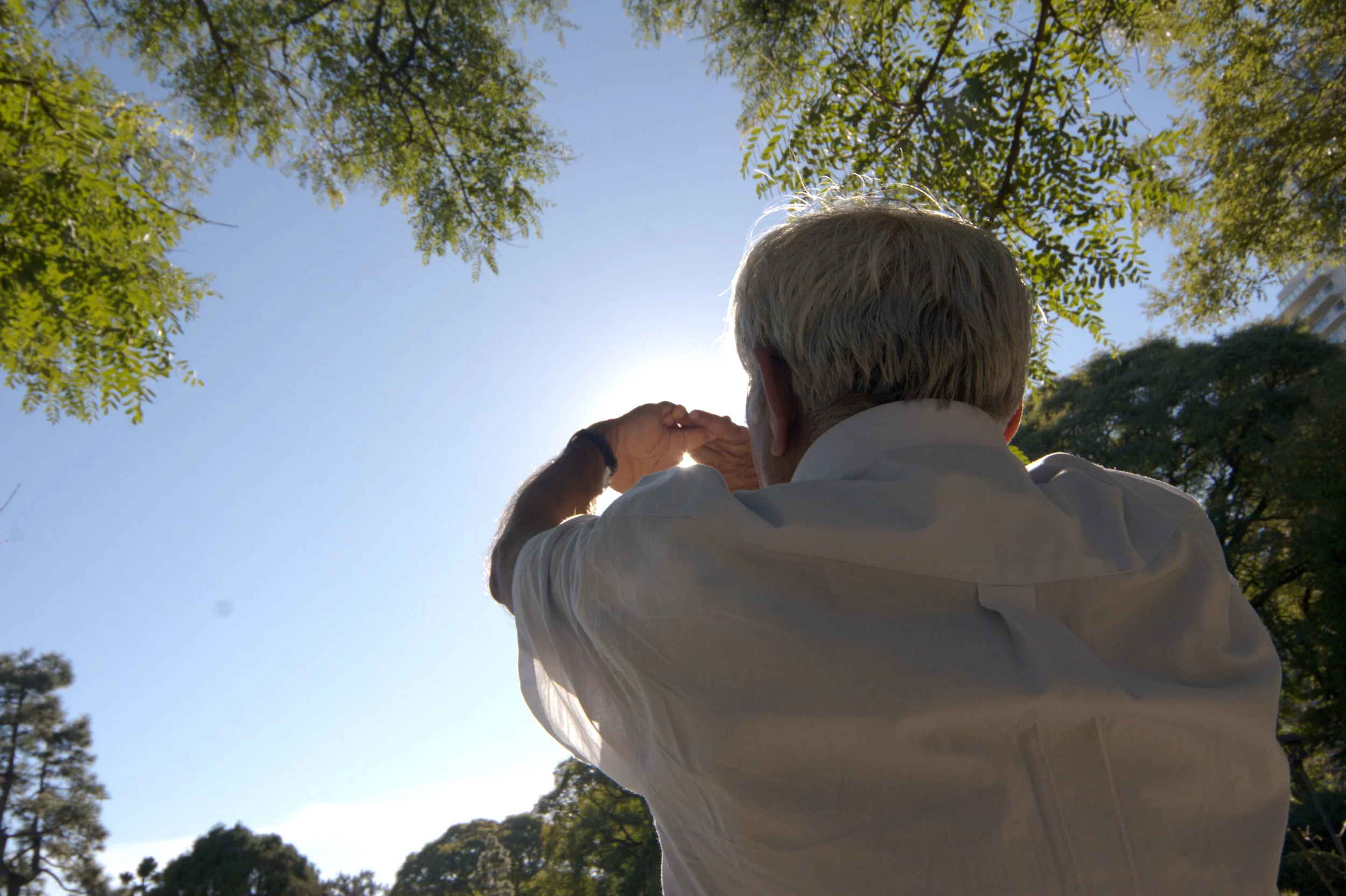
TKV Desikachar looking toward the sun! The Son is indeed shining! Photograph © Kausthub Desikachar
A Tradition with a Pulse
Ancient teachings face a unique challenge. If they last long enough, people often admire their age but forget to ask how they actually help. They might be preserved, quoted, and remembered, but are they still alive for those who learn from them?
For my father, TKV Desikachar, this was not just a theoretical issue. He received a remarkable legacy from his teacher and father, T. Krishnamacharya. His job was to ensure this legacy continued to help people, even as their lives changed from those of the past.
He took this responsibility seriously, showing deep respect and practical, engineering-like thinking. A bridge, no matter how well designed, must let people cross. In the same way, a teaching must reach the person who needs it.
Watching him, I realised that his respect for tradition and his kindness went hand in hand. The same insight that helped him adapt a practice also helped him see when a scared student needed comfort, when a rule needed to be questioned, or when the best lesson was just a smile.
Old Wisdom, New Circumstances
Much has changed since classical Yoga teachings first appeared. Our daily routines, family lives, jobs, and even our connection to nature are very different now. Even in one generation, things that once felt normal can start to seem unfamiliar.
So it makes sense that people wonder if ancient teachings still matter. Can wisdom from a very different world still speak to someone whose day is filled with traffic, deadlines, and a phone that never seems to leave their side?
My father’s teaching gave a thoughtful answer. Life changes, but we still need clarity, connection, and support during hard times. The real challenge is seeing how a teaching can meet each person's needs.
This takes more than swapping a Sanskrit word for a trendy English one. It means knowing what a practice is meant to do, what the student can take in, and how those two can come together. If not, we might keep the instructions but lose their real meaning.
My father took both parts of this responsibility seriously. He studied hard to understand what he received, and he listened closely to see how it could help others.
When Stories Open Doors
One difficulty in receiving ancient teachings lies in how we learn to understand them. In many traditional Indian households, children encountered stories of deities, sages and extraordinary adventures long before they could explore their philosophical implications. The story came first. Its deeper significance could unfold later.
A child might enjoy a fantastic journey or a tough challenge. Years later, that same story could help them understand their own struggles. What was once just fun could begin to teach. Symbols gave a language that grew with the listener.
This way of learning is hardly confined to India. Many cultures have used stories to prepare the imagination for truths that explanation alone cannot convey.
Stories are still part of childhood today. But when learning focuses mostly on what can be tested or repeated, there is less room for meanings that take time to grow. We might get good at remembering facts but not as comfortable with uncertainty, symbols, or reflection.
My father knew that not understanding this kind of language wasn't the student's fault. The teacher had to see that. If a symbol didn’t make sense to someone, saying it louder wouldn’t help. A different way in was needed.
At the Temple Door
One encounter captures this sensitivity particularly well. An Indian woman who studied with my father had been diagnosed with breast cancer. Knowing her faith in God, he decided to accompany her to a temple so that they could pray together.
Prayer naturally belonged in his own life. He had also seen his father turn towards the Divine in difficult circumstances. For this student, the temple offered a familiar place in which to seek comfort and strength during a frightening time.
But at the entrance, she hesitated. She was menstruating and believed that this made her “unclean”, and therefore unable to enter.
My father responded by restricting the context of sanitary conditions in earlier times. He urged her to consider the circumstances behind such conventions. He reassured her that what mattered for their prayer was a clean mind and sincere intention.
Because of his response, she could go in and pray without feeling she had done something wrong. The doorway that once made her anxious became a way to find comfort again.
What touches me about this story is how gently he responded. He didn’t mock her hesitation or act like her faith was childish. He saw how much it mattered to her and helped her find strength in it.
She already had enough fear in her life. He saw no reason to add more in God's name. He wasn’t going against tradition either. Tradition says that when a higher purpose calls, some rules can be set aside if the situation calls for it. Her serious illness deserved that care. She wasn’t entering the temple as a casual tourist, but as a fearful pilgrim who needed grace. In that moment, helping her faith and easing her worry honoured what tradition is really about.
Respect without the Throne
This freedom deserves to be understood against the background of my father’s own education. He studied with Krishnamacharya within a disciplined, traditional relationship. Students sat below the teacher. Lessons began with prayers honouring teachers and deities. Forms of address expressed respect.
These practices mattered in that setting. They fostered humility, focus, and a genuine sense of learning. My father took part in them as a dedicated student, and even later, he stayed grateful for the education they gave him.
But he didn’t expect every student to follow the same customs. Many called him by his name. They might sit across from him at a table. He included prayers only when they fit the student’s beliefs, rather than making unfamiliar rituals required.
He knew that following rules on the outside doesn’t always mean someone is sincere inside. A person can sit below a teacher but still feel superior. Someone in a regular chair might actually be listening with real humility.
The height or luxury of the furniture doesn’t show how much respect someone has.
We might misunderstand Krishnamacharya if we judge him only by today’s standards. What looks conservative to us might have seemed open-minded or even bold in his own time. Tradition is more complicated than it seems from far away.
My father’s example encourages us to look past appearances and ask what purpose a tradition or form really serves.
A Little Too Close for Comfort
Sometimes, the answer to that question came with a lot of laughter.
In May 2005, my father travelled with our family through eleven countries to share his father’s teachings. One stop was Montréal, where the seminar audience included both French- and English-speaking participants.
Daniel, one of my students who helped organise the seminar, offered to translate. He sat on stage between my father and me. Usually confident and funny, he became much more nervous than he expected when translating for my father. His nerves started to affect his translation.
My father asked him to sit closer, thinking that this might help him hear better.
But sitting closer didn’t help. Being even nearer to the person who made him nervous just made Daniel more anxious. His translation got worse.
My father invited him closer again.
At this point, Daniel called upon the resource that had perhaps deserted him temporarily: his sense of humour. He got up and sat on my father’s lap.
The room fell silent.
The audience held its breath, wondering what would happen next. Had Daniel gone too far? Would my father be upset? Would the talk turn into a lesson about proper behaviour?
My father smiled, patted Daniel on the back, and said, “Relax. Take a deep breath.”
The tension dissolved into laughter. Daniel recovered his confidence, and his translation improved.
The Lesson beyond the Lecture
I treasure that moment because it shows something a list of my father’s achievements could never explain. He understood what the person next to him was feeling.
Daniel felt overwhelmed. My father could have seen it as disrespectful, but instead, he noticed Daniel’s nerves behind the joke and responded in a way that let Daniel recover without embarrassment.
The audience also gained something important. They saw a respected teacher who didn’t need to prove his status by putting others down. His calmness helped everyone relax.
It takes real generosity to help someone regain their dignity without making a show of your own kindness. My father had that gift. He could ease a tough moment and still let the person involved feel whole.
This was part of how he taught Yoga. It showed how well he noticed, understood, and responded. Knowing a good technique is one thing, but seeing what someone needs in the moment takes something extra.
That afternoon, a simple reminder to breathe worked because it was given with warmth. The words were ordinary, but the relationship made them powerful.
No Robes Required
In the late 1990s, a woman from South Africa arrived at the Krishnamacharya Yoga Mandiram, one of the two centres my father founded during his lifetime, for an appointment with him. She had never seen him, even in a photograph. While waiting in the lobby, she noticed a man passing and asked whether “Swamiji Desikachar” would be coming soon.
The man assured her that Desikachar would meet her at the appointed time.
A few minutes later, she was shown into the consultation room. There sat the same man.
“I am Desikachar. How can I help you?”
She was astonished. He couldn’t be the person she expected. Where were the orange robes? Where was the long, flowing beard? He looked far too ordinary.
“You are just like me,” she protested.
My father smiled. “Madam, I am not a Swamiji, but I am the Desikachar with whom you have an appointment. And yes, I am just like you.”
It’s a charming story, but the last sentence matters. He didn’t use her confusion to show off how special he was. Instead, he accepted the simple humanity she brought up.
She had arrived looking for someone who looked different from herself. He began by acknowledging what they shared. That was a promising place for a relationship to begin.
The Greatest Thing
One student expressed this quality beautifully, describing my father’s humanity and his ability to bring happiness simply by being in the room. Although he was initially intimidated, the student felt encouraged to look within rather than expect the teacher to have every answer.
“What is good in him is the same in me, too,” the student observed.
For me, this connects the temple visit, the classroom, and that special afternoon in Montréal. In each place, my father’s knowledge supported a relationship. He could use tradition without making anyone feel small.
His example also gives us, as teachers, a responsibility. Changing a tradition takes real study and care. We can’t just throw out what we don’t like. At the same time, keeping a tradition means noticing when an old way no longer helps the person it was meant for.
My father balanced these responsibilities by always paying close attention to people. His kindness put his learning into real action.
I remember a man who could pray with a scared student, welcome someone with different beliefs, and laugh when a nervous translator sat on his lap. He knew so much, but he was never too important to connect with others.
Maybe this is how a tradition stays alive today: someone understands it well enough to let it speak kindly in the present.
And sometimes, after all the learning, the most meaningful words are the simplest ones.
“Yes, I am just like you.”
This article was first published in the Yoga Magazine UK in the December 2026 edition. To download the article as a pdf click here>