
The Heart of Yoga!
How the Yogasūtra-s Remained TKV Desikachar's Greatest Lifelong Companion
by Dr Kausthub Desikachar, PhD
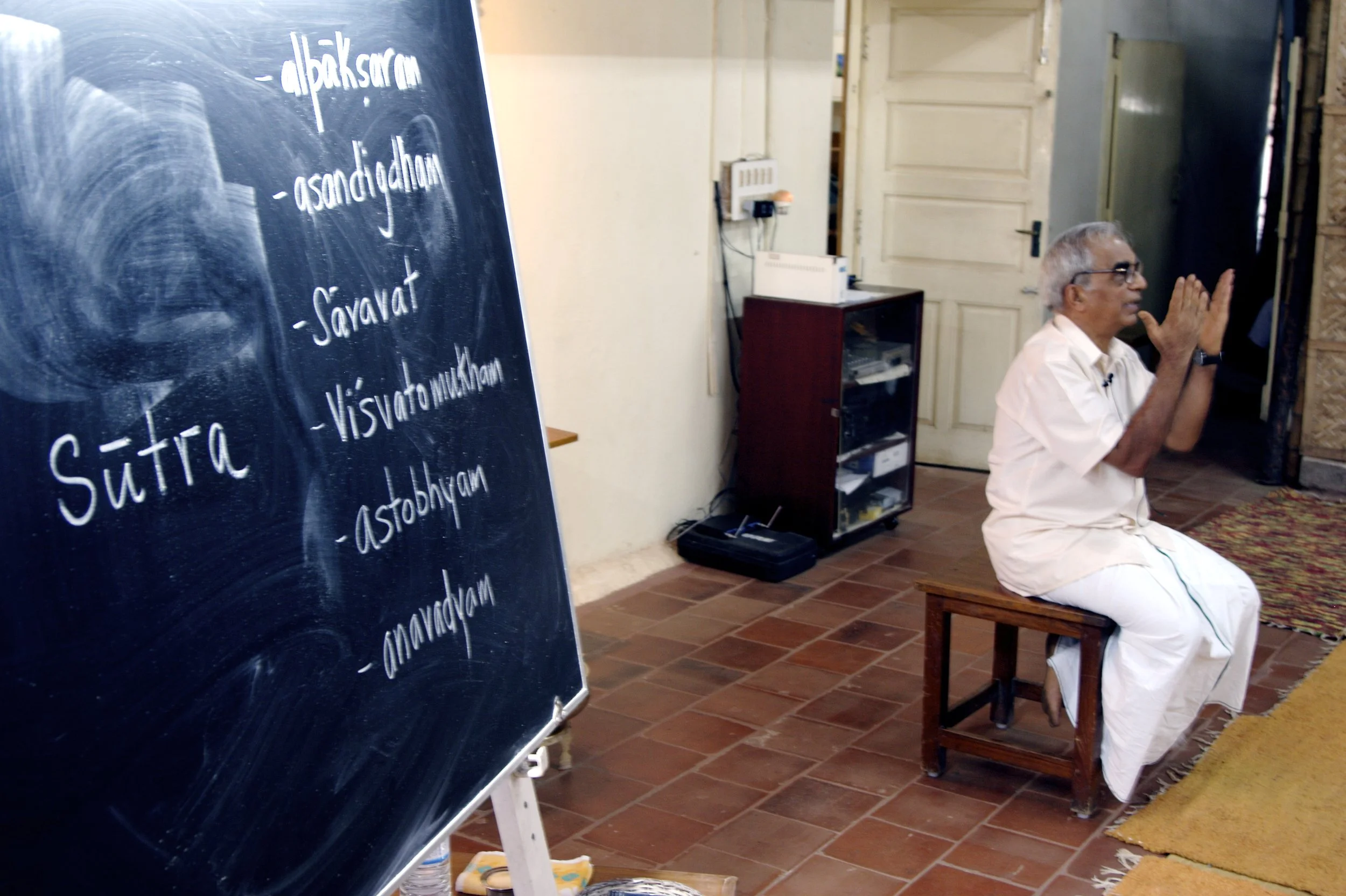
TKV Desikachar teaching Yogasūtra to his students.
Ancient Words, Living Wisdom
Few texts in human history have shaped an entire spiritual tradition as profoundly as the Yogasūtra-s of Patañjali. Composed nearly two millennia ago, these concise aphorisms remain the philosophical heart of Yoga, exploring the nature of the mind, the causes of suffering, and the possibility of lasting inner freedom with remarkable clarity and depth. For generations of teachers, they have served not merely as a book to be studied, but as the ultimate touchstone against which authentic Yoga has been understood and transmitted.
Today, the Yogasūtra-s hold a prominent position in teacher training programmes, scholarly discourse, and Yoga literature worldwide. Their influence is now so extensive that it may appear they have always been central to international Yoga education.
However, this prominence is a relatively recent development.
When Yoga first began spreading rapidly through Europe and North America during the latter half of the twentieth century, most practitioners encountered it primarily through āsana. The physical discipline of Yoga captivated the modern imagination, but its philosophical foundations remained largely unfamiliar. Outside a relatively small circle of Sanskrit scholars and devoted practitioners, few had heard of Patañjali, let alone explored the Yogasūtra-s with any depth.
Among those who quietly transformed this landscape was TKV Desikachar.
Over several decades, through his teaching, writings and training programmes, Desikachar introduced countless practitioners to the wisdom of the Yogasūtra-s. For many students around the world, their first meaningful encounter with Patañjali’s teachings came not through a university lecture or an academic commentary, but through sitting with a teacher who possessed the rare gift of revealing how these ancient aphorisms could illuminate the challenges of modern life.
Yet what distinguished Desikachar was not simply his ability to explain the Yogasūtra-s; it was the authenticity with which he taught them.
Long before he became recognised internationally as a teacher, therapist and author, he had spent decades immersed in the text under the direct guidance of his father, Professor T. Krishnamacharya. His understanding was not acquired through academic study alone, but through the traditional guru–śiṣya relationship, where knowledge is transmitted patiently until it becomes inseparable from life itself.
For Professor T. Krishnamacharya, the Yogasūtra-s were the very foundation of Yoga. Although his scholarship embraced the Veda-s, Upaniṣad-s, the Bhagavad Gītā and countless other sacred works, it was to Patañjali that he consistently returned when explaining the principles governing Yoga practice. Every method, every therapeutic adaptation and every innovation ultimately had to remain faithful to the vision expressed in the Yogasūtra-s. This unwavering commitment became one of the defining characteristics of the Krishnamacharya tradition, and it was the inheritance Desikachar received.
Nine Journeys Through the Same Text
Most students consider themselves fortunate if they have the opportunity to study a great scripture once under an accomplished teacher. Desikachar received a far rarer blessing.
Over the course of nearly three decades, Professor T. Krishnamacharya taught his son the entire Yogasūtra-s on nine separate occasions.
From a contemporary perspective, such repetition may appear unnecessary. However, within the traditional guru–śiṣya relationship, a sacred text is never exhausted by a single reading. While the words remain constant, the student evolves.
Each time Krishnamacharya began again with the opening Sūtra, Desikachar returned as a different person. As the years unfolded, he became an engineer, a husband, a father, a therapist and eventually one of Yoga’s foremost ambassadors. With every new responsibility came fresh questions and deeper experiences. Aphorisms that had once appeared straightforward revealed unexpected subtleties, while passages that had seemed philosophical suddenly became intensely practical.
In every meaningful sense, this process constituted not a single education, but nine distinct journeys through the same text.
This gradual unfolding illustrates a fundamental aspect of how sacred knowledge has traditionally been transmitted in India. Modern education often assumes that mastery is achieved by completing a subject and progressing to the next. In contrast, the guru–śiṣya tradition is founded on a different premise: certain texts possess such depth that they cannot be fully comprehended within a single lifetime. These works are not merely studied; they become lifelong companions. Individuals revisit them repeatedly, finding that while the words remain unchanged, personal understanding matures through experience.
Desikachar would later come to appreciate that his father had never been teaching him the Yogasūtra-s alone. He had been teaching him how to read them. Each successive journey cultivated greater patience, sharper observation and deeper humility, reminding him that wisdom is rarely acquired in a single moment of insight. More often, it reveals itself gradually, almost imperceptibly, as life itself becomes the commentary upon the text.
Analogous to returning repeatedly to the same mountain, each ascent revealed previously unnoticed aspects. Although the mountain remained unchanged, the traveller perceived it differently with each visit. Similarly, the Yogasūtra-s possess a brilliance that lies not only in their content, but also in their exceptional capacity to reveal deeper meaning as an individual's life experience matures.
Looking back on those decades of study, my father often spoke with profound gratitude for the privilege of learning directly from his own father, my grandfather. Those years shaped far more than his intellectual understanding of Yoga. They cultivated a way of listening, reflecting and living that remained with him throughout his life.
The ninth and final journey, however, was unlike all the others.
Having spent decades transmitting Patañjali’s wisdom to his son, Ācārya Krishnamacharya chose to reveal something deeply personal: his own commentary on the Yogasūtra-s. This remarkable work, later titled Yogavalli, was dictated directly to Desikachar in Sanskrit. More than a scholarly commentary, it represented the distilled reflections of a lifetime devoted to contemplating, practising and teaching the Yogasūtra-s. In many respects, it was Krishnamacharya’s final offering to the tradition he had served so faithfully, the Visiṣṭādvaita-sampradāya.
For Desikachar, receiving Yogavalli signified the onset of an even greater responsibility. The wisdom he inherited was now entrusted to his stewardship, not as a personal accomplishment, but to be preserved, embodied, and ultimately shared with a wider audience.
When the Student Changes
The significance of this extraordinary training became fully apparent only when Desikachar began teaching internationally.
As invitations arrived from Europe, North America and beyond, he encountered students whose cultural backgrounds differed profoundly from those in which the Yogasūtra-s had traditionally been studied. They approached Yoga with sincerity and enthusiasm, yet many had never encountered Sanskrit, symbolic modes of learning or the oral traditions through which the text had been transmitted for centuries.
The primary obstacle was not a deficiency in intelligence or commitment; rather, it was the transformation in the student population.
Modern education generally encourages understanding before memorisation, explanation before contemplation, and analysis before repetition. Faced with nearly two hundred concise aphorisms in an unfamiliar language, many students became overwhelmed long before they had the opportunity to appreciate the extraordinary wisdom they contained.
Desikachar recognised that if this trend persisted, the Yogasūtra-s risked becoming inaccessible, not due to their inherent complexity, but because of the pedagogical approaches employed.
As both therapist and teacher, he had learnt that every genuine transformation begins by understanding the individual before you. The same principle, he realised, applied equally to education. The challenge was not to change the teaching, but to help students discover a path into it.
Building Bridges, Not Shortcuts
Before introducing any new approach, Desikachar discussed the matter carefully with Professor T. Krishnamacharya. Only after receiving his father’s blessing did he begin developing a gradual method of introducing students to the Yogasūtra-s.
Rather than asking beginners to memorise lengthy aphorisms in their complete form from the outset, he divided them into smaller grammatical units, carefully observing the rules of Sanskrit grammar, pronunciation and phonetics. Students could first become familiar with these shorter parts before progressively learning each Sūtra in its classical form.
The strength of this approach resided in its refusal to compromise the integrity of the Yogasūtra-s. The text itself remained unaltered: no philosophical concepts were simplified, no meanings diluted, and no effort was made to modernise Patañjali’s teachings. Desikachar preserved both the destination and the tradition, instead creating a more accessible path for dedicated students. Once students developed confidence and familiarity, he consistently guided them back to the classical method through which he had learned from his father.
In 1985, this vision found expression in the publication of Patañjali’s Yogasūtra-s. More than another translation, the book reflected a carefully considered educational philosophy shaped through decades of observation, reflection and teaching. For countless practitioners, it became the first doorway into a lifelong relationship with the Yogasūtra-s.
In retrospect, a consistent approach is evident throughout Desikachar’s work. Whether adapting āsana to individual needs, illustrating complex practices with his well-known stick figures, or developing a progressive method for learning the Yogasūtra-s, his purpose remained constant. He did not attempt to diminish the tradition’s depth; instead, he focused on eliminating unnecessary barriers that hindered sincere practitioners from accessing that depth.
The Heart of Yoga
Even with these innovations, Desikachar sensed that another challenge remained. Students were becoming increasingly comfortable with chanting and memorising the Yogasūtra-s, yet many still struggled to recognise how these ancient aphorisms related to the realities of modern life.
What they needed was not merely another translation.
They needed a companion.
It was from this insight that The Heart of Yoga emerged. Since its publication, it has become one of the most respected books on Yoga in the world, introducing generations of practitioners to the philosophical foundations of the tradition through the living teachings of Professor T. Krishnamacharya.
However, the deeper significance of this work is sometimes overlooked. In many respects, it functions as a supportive companion to the Yogasūtra-s, demonstrating how Patañjali’s insights are expressed within āsana, prāṇāyāma, meditation, ethics, relationships, and the practical challenges of daily life. The complete Yogasūtra-s are included, yet always presented in a manner that fosters understanding rather than intimidation.
For many readers, The Heart of Yoga marked a pivotal moment in the understanding of Yoga. What initially appeared as a physical discipline gradually emerged as a profound exploration of the human mind and the potential for inner freedom. In guiding readers toward this deeper dimension, Desikachar did not introduce a new philosophy; rather, he restored Yoga to its philosophical core.
Preserving the Voice of His Teacher
As Desikachar’s work expanded across the world, another responsibility rested quietly upon his shoulders. Alongside helping students understand Patañjali’s teachings, he recognised the need to preserve the unique interpretation he had inherited from Professor T. Krishnamacharya.
It was Desikachar who encouraged his father to compose a complete commentary on the Yogasūtra-s. The resulting work, Yogavalli, preserved decades of reflection that might otherwise have remained only within the intimate conversations of teacher and student.
Desikachar did not consider this manuscript as his personal property. Consistent with all he had received from his father, it was regarded as a trust rather than a possession. Its purpose was not to advance his own reputation, but to ensure that his teacher’s voice would continue to guide sincere students in the future.
A Living Tradition Must Continue to Speak
Throughout his life, Desikachar demonstrated that a living tradition is not preserved by resisting change at every turn, but by discerning carefully what must remain eternal and what may legitimately evolve.
This conviction shaped not only the way he taught the Yogasūtra-s, but also the way he viewed his own writings. In his later years, he expressed the wish that many of his earlier works should one day be revisited so that future generations could continue to understand them with clarity while remaining completely faithful to their original intent.
One expression of that vision is Truth Unclouded, a new translation and commentary on the Yogasūtra-s, developed in accordance with Desikachar’s own request that his earlier work be refined for contemporary readers. At the same time, Yogavalli, once dictated from Professor T. Krishnamacharya to Desikachar, is now being carefully translated into English, allowing the master’s final commentary to reach a wider audience for the first time. As his son and successor, I continue this work in the spirit of a lineage of careful transmission and stewardship, a responsibility I am privileged to have inherited.
The Root and the Branches
A retrospective examination of these three generations reveals a remarkable consistency of purpose.
Professor T. Krishnamacharya devoted his life to studying, embodying and transmitting the wisdom of the Yogasūtra-s. TKV Desikachar carried that same wisdom across cultures, introducing countless practitioners to Patañjali's teachings while remaining unwaveringly faithful to the tradition from which they came. Today, that work continues through my own efforts: through the translation of Yogavalli and through the ongoing refinement of Desikachar’s presentation of the Yogasūtra-s in Truth Unclouded.
Across these three generations, languages have changed, audiences have expanded, and teaching methods have naturally evolved. Yet the purpose has remained constant. None approached the Yogasūtra-s as something to be owned, marketed or reshaped according to the fashions of the day. Their scholarship was never an exercise in personal prestige, nor a means of profiting from the growing corporatisation of Yoga. Rather, each received the tradition with gratitude, dedicated a lifetime to understanding it more deeply, and sought only to pass it on with greater clarity than they themselves had received.
This may represent TKV Desikachar’s most significant scholarly legacy. He did not merely author influential books or introduce generations of students to the Yogasūtra-s. He contributed to the continuation of an unbroken dialogue that originated with Patañjali, was further developed through the insights of Professor T. Krishnamacharya, transmitted across cultures by Desikachar with compassion and fidelity, and now extends into subsequent generations.
Traditions endure not through unchanging preservation, but because each generation receives them with humility, develops a deep understanding, and transmits them in service to a greater purpose. This ethos characterised the approach of Professor T. Krishnamacharya, TKV Desikachar, and their successors to the Yogasūtra-s: not as proprietors, but as dedicated custodians. Within this spirit of stewardship resides both the enduring relevance of the Yogasūtra-s and a fitting tribute to the life and work of TKV Desikachar.
This article was first published in the Yoga Magazine UK in the September 2026 edition. To download the article as a pdf click here>